Monday, October 31, 2011

26 per cent of Brits support EU membership; 100 per cent of their political betters support it

And yet, facing imminent surgery for cancer, I'm still obsessed with European politics.

...polling makes the British public's position devastatingly clear (summary here). It shows that just 26 per cent view our EU membership as a good thing.

Yet this is the view of 100 per cent of the main parties in the House of Commons. There is a large democratic deficit here, a gap that might yet be filled by another party.


...these issues are complex, lawyerly – can we expect ordinary folk to reach an informed opinion based on a hunch? Does the bouncer's opinion count for as much as the barrister's?

To me, this questions cuts to the very nature of left vs right. I'm a free marketeer because I believe that the masses are smarter than the elites.

Stanford academic Thomas Sowell argues that the world is so complex that no one person can possess "even one percent of the knowledge currently available, not counting the vast amounts of knowledge yet to be discovered". So, "the imposition from top down of the notions in favour among elites, convinced of their own superior knowledge and virtue, is a formula for disaster".

Hence central planning, the Soviet Union, etc. As Sowell says, the real ideological fault line – rather than the diminishingly useful party political labels – can be drawn here.

How do you define knowledge? Do you see it as something that is concentrated (i.e. in universities and libraries) or spread across society? If you believe the former, then you're on the side of the Polly Toynbees and the Tory Paternalists who believe power (and money) should rest with an enlightened elite.

If you believe the latter, then you'll be in favour of transferring power to the many, not the few, and be against nicking their cash.


I think this is the problem with the whole left/right paradigm, as it is now manifest in American politics. I thought it was interesting that the OWS "protesters" used the term "Republican" exclusively as a political insult. I imagined what they would make of me, a right wing Anglo-Canadian who lives in Europe. I would obviously have had to correct them if the epithet Republican were aimed at me, because I am not an American and, frankly, don't know very much about the details of American politics (it's not my beat).

The idea that Fraser Nelson puts forward above shows a basically stagnant, and unwinable, situation in the political realms in Britain and the US. While in most of Europe, the "right" has failed and when one is presented with even the most extreme, fringe "right wing" parties like the BNP you find that a brief analysis shows they are still in favour of state-enforced wealth re-distribution that we used to recognise as socialism.

What is needed is a genuine new paradigm. I am not myself qualified to offer one, but I believe that the Catholic Church offers a solution that transcends the inescapable battle over class wars, top-down elites vs. freemarketeers. The trouble with the Marxian paradigm is not that Marxism, whether cultural or the more direct kind in China and the former Soviet Union, presents a threat to the "free world". It is that the Marxian worldview, the framework and terminology presented by the Marxist idea, has cornered the market on political thought. No one in the business of political and economic ideas seems capable of thinking outside the Marxist box.

No one, including the left in the Church, seems to have read the social encyclicals in the context of Catholic moral teaching.

I wonder, however, if a door and a path out of the interminable lockdown of the Marxist paradigm, can't be found by looking there.


~

The Home Stretch

I'm back to the Gemelli tomorrow morning, with surgery scheduled for Wednesday, and will probably be there for the rest of the week. They will use laparoscopic surgery to remove the tumour, then send the tissue to the lab for examination. This histological examination will tell them if there is any cancer left alive to worry about. If the answer is no, then we will be finished.

I'm going to bring the computer and the mobile internet stick to the hospital to keep myself entertained. Don't know how much posting I'll be able to do, but I'll give someone the passwords to this and to the FB acct, and let y'all know if they've accidentally cut my head off.

HJW


~

Sunday, October 30, 2011

Books

Well, I think the time has come to let the cat out of the bag.

I've decided to write a book. I want to write about my combined experience of coming to live in Italy and learning to be an artist.

When I was diagnosed with cancer, and while I was going through the process of dealing with it mentally and emotionally, I found that my long-time problems with depression, perhaps surprisingly, have been greatly eased. I have been thinking a great deal about this, but not writing much about it. I think I have talked a bit about how cancer forces you to deal in the here and now with what's really going on. And depression is largely about succumbing to Fantasy. The conflict in your mind between The Real and Fantasy is, I think, largely what causes depression.

Two things have greatly affected this conflict: studying art and dealing with cancer.

All while living in a weird foreign country where I don't speak the language very well and am far away from all that was familiar.

The book will be about all these things: living in Italy as an Anglo-Canadian ex-pat, studying art, and dealing emotionally and spiritually with cancer.

One of the things I need to help with all of this is a few books. One of the ancillary consequences of the revival of serious art instruction is a burst of re-publishing of old classic art instruction texts. I have put a link to my Amazon wishlist on the sidebar. If any of you are inclined to lend a hand in this project, I would be very grateful to receive any of the books on the list.

One of the things I found myself wanting very much when the cancer thing was over was to be able to do more. More work, more art, more writing, more Italy, more museums, more reading, more gardening, more travel. More life. Life is happening now and I can't slow it down. I think I want to start running to keep up.

My three highest priorities after looking after my health, must be work, art and the book. This may mean that blogging will slow down a bit. Or a lot. I'll think about this some more.

HJMW


~

Saturday, October 29, 2011

Another contemporary realist blogs

Stapleton Kearns studied with R.H. Ives Gammell, a major link in the great chain of the classical realist revival movement.

It is very difficult and takes a lot of determination to learn to do the art thing without the direct in-the-flesh help of a competent instructor, but it is not impossible. Recently, there have been a number of books published, either old books renewed by such outfits as Dover, or new books on old subjects by contemporary instructors like Juliette Aristides.

It may sound a bit silly, but there is also YouTube that has a great vast panorama of videos showing speed drawings and some giving pretty good instruction on the basics, things like how to handle charcoal, basic stuff about values and the use of various media.

There is also an increasing number of working and teaching artists who blog and who make videos, like Sadie Valeri (I really wish she would do more videos) and Scott Waddell, some of whom I have found and looked at and used myself and who are featured on the sidebar.


A big part of what you have to overcome is your fear. It can be very difficult for adults to endure being bad at something long enough to get better at it. As y'all know, a huge part of my process has been to overcome my fear of being really crummy at first. But this fear is the biggest obstacle to making progress.

That and sheer laze, of course.

But the thing that can really help is success. Even a little success. A little sketch that turns out looking like the thing. Even a little part of a drawing that you particularly like. When I did my first still life in charcoal, the silver tea pot on a linen drapery, I had a really hard time, struggling with learning how charcoal works and how to make the grey scale toned paper take up some of the slack in the values. All issues I am still working on. But in that drawing there is one little bit, the part where the little feet of the tea pot sit on the cloth and the shadow goes out behind them. I love that bit, and it really encouraged me to try another one.

I think I wrote about how I have this mean bully in my head that was constantly barking at me about this whole thing being a waste of time, that I'm no good at it and ought not to bother, that I'll never be as good at it as I want to be, and how I ought to just pay attention to things I already know I'm good at, like words.

This inner bully, I refer to as the Talking Brain. Drawing Brain doesn't really communicate in words and abstract things like symbol systems, so it is easy for it to be silenced by the mean schoolyard bully Talking Brain. Fortunately, I have The Will, which I liken to the nice teacher who runs blockage for the bully, encourages the quiet kid to just get on with it and see how things turn out.

I am also learning that Fury can be a great help. Fury comes in when I can't get it right. I become so furious that I keep doggedly trying and trying until I get it right. But I think this system is somewhat inefficient.

What to do about Sheer Laze, I have not yet figured out.


~

Trois Crayons


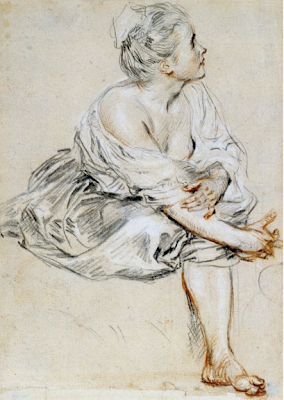
The still life I'm trying is on medium tone grey scale paper which I bought because I am enamoured of the drawing technique called Trois Crayons, the three pencils being charcoal, sanguine and white chalk on grey or tan toned paper. The most renowned practitioner of this technique was Watteau.

But of course, it was used by all the great artists either as an art in itself or, more commonly, as a preliminary to painting.


Here is a trois crayon drawing of Sir Thomas Elyot by the greatest portrait master of all time, Hans Holbein.

Trois crayons is the drawing technique that most fascinates me. So far, I've been strictly using pencil to learn to see with. Went to a figure class this week and did pretty well with the proportions and whatnot, so that's coming along.

I also finished my third Bargue this week,


the side-view horse head. This took me about 50 hours all together.


This is Andrea's Bargue horse head from when she was a student at the Florence Academy. It shows how much this course is a handed-down tradition. I once found Picasso's version of a Bargue student drawing, the same one I was working on at the time. Mine was way better. Picasso always sucked.


(Pictured: not mine. Someone else's)
But the fourth class thing is going to be Bargue's Belvedere Torso in charcoal which I'll start on November 21 and work on for three classes until Andrea goes to Australia. I am greatly looking forward to it because I really need instruction in charcoal.

Skills with charcoal and sanguine are what you develop when you do the


trois crayon technique.

One of the main things I wanted at Zecchi in Florence was some chunks of pure sanguine that you can get almost nowhere else. They didn't have much left but the lady brought out a big plastic box that had several fist-size chunks and a whole lot of powder and little broken-off bits. I realise now I should have bought a big bag of the powder and little bits as well.

Pure sanguine - the batch I got at Zecchi has a nice pinkish glow - has some interesting properties, one of which is its great friability and smudginess. As I've been fooling about with the chunks, I've been trying several ways to use it. It blends beautifully. You can take a bit of it, sharpen with a knife and a piece of sandpaper, and use it straight on the paper getting a nice clean line. You can grate it on a cheese grater and mix the powder with water and use it as a kind of red ink that has very pleasing effects. You can apply the powder directly to the paper and blend it all over with a tissue or sponge to tone white paper.

I also picked up a couple of white chalk pastels which lay down a much thicker layer of white than either a conte or a white chalk pencil. White chalk pastel goes over top of other mediums and can be used right over top of charcoal, but someone out there in the art internet said that a little touch of gouache paint does the same thing only better and recommended touching up the chalk or pastel highlights once the drawing is finished. It also happens that I have a little tube of white gouache.

A while ago, enchanted as I am with what I now know is called Trois Crayon technique, I bought some big sheets of grey scale paper. With the Dramatic Tea Pot still life, I realised that it is going to be a perfect subject to do the three colours, the white linen table cloth and tea pot are white with grey shadows ideal for rendering in charcoal on a grey background, and the carved wood screen as background can be all done in various shades of sanguine.

We'll see how it goes.


~

Friday, October 28, 2011

Bean Pickles


Many years ago I grew my favourite garden thing in all the world, scarlet runner beans. When the harvest time came, I realised I had way more beans than we could eat before they either got too big and tough on the vine or went funny in the fridge. I was reluctant to freeze them, so I made them into pickles.

The other day, a friend gave me a jar of her absolutely wonderful tomato chutney. She makes a small batch every year and gives little teeny precious bits of it away to friends. I decided to reciprocate this nice gift with a jar of pickled beans.

Yes, it sounds weird, but they're way better than they sound.

I couldn't find Scarlet Runners here in Italy, but I got a big bag of something close from the local farmers' market.

Looking around for a recipe, I came across this cool site.

Food in Jars.

For those who long for lost domestic skills.

When I find the recipe, I'll let y'all know.

UPDATE:

Turns out it's incredibly easy. I did two batches, one where I steamed the beans a couple of minutes to just barely soften them, and the other batch the beans are raw. I added some carrot slices and cauliflower florets.

I didn't really measure anything, just winged it instead, soooo:

Equal parts white wine vinegar and water
generous scoop of sea salt (maybe a cup for the whole thing)
smaller scoop of white sugar.

Cut up about a pound of beans, three large new carrots, and a fist-size clump of cauliflower.
Slice in to large chunks some fresh garlic and dried Thai chilies.

Other than that, you will need pickling spice and whole bay leaves.

Boil the vinegar, water salt and sugar together until the salt and sugar are dissolved and the whole thing is on a light rolling boil.

Wash your jars in nice hot soapy water. I don't have the equipment to boil the jars so I took a tip from my Auntie Gill who said that after you wash them it works just as well to stick them in a hot oven for 20 minutes. Wash the lids (the plastic coating is where mould spores tend to collect) and then boil them in water and salt.

Allow the jars to cool on the counter for a few minutes before putting anything in. This is important, since even though it is boiling, the brine will still be cool enough to crack the hot jars. Learned this one the hard way when I lost my best hinge-top jar making peach preserves last year.

The jars can still be pretty hot when you pop the beans in together with the other veg, a bay leaf each, a few large chunks of garlic and a few of the sliced chilies.

While the jars are still hot, and when the brine is on the boil, pour the brine over the veg to completely fill up the jar, right to the rim. Fish the right lid out of the boiling water and put it on very tightly. You know you have done it right when the little button things on the lids are depressed. As they cool, if there is a seal, the thingy doesn't pop down when you push on it.

The batch I did made four large-ish jars of pickles. Let them sit in a cupboard or other cool dry place for three weeks to three months. If you feel like you want to do something, you can shake and turn them, but this is only to make you feel like you've got something to do, it doesn't make a lick of difference to the pickles.


~

Thursday, October 27, 2011

"Never his mind on where he was, what he was doing..."

The Bad Catholic writes:
Thought Experiment: Two people are watching a beautiful sunset. The first person watches. The second person pulls out his iPhone, snaps a shot, tweets it with a caption ‘watching a beautiful sunset’ then gets back to watching the sunset. Who is watching the sunset?

The second has certainly conquered the moment. It has been captured, sent, and subjugated to description. But I hold that the greatest moments should conquer us. All moments should conquer us. That’s what it means to be open to God; to be open to having our wills entirely conquered. To live in the present moment is to live with the willingness to be swept away. Is to name moments – to update your status with them – to lose them? Maybe. Sometimes.


I don't "Tweet," and I use Facebook for work and to keep in touch with friends, (not, by the way, "friends". Something I really don't get about Facebook is this weird habit of just collecting masses of people on your list whom you don't know. Maybe I have totally misunderstood the purpose of Facebook, but I get loads of "friend" requests from people I've never heard of. I always refuse them, but it's weird and slightly creepy.) When I post status updates, it's mostly to keep people I know either personally or through work updated on my cancer issue. I use it to make jokes that only my friend will get and to upload photos because Mac has an automatic thing that makes it much easier. I have moved around the world a lot in life and have really liked having Facebook to help me not entirely lose the people who stayed behind. But I see people with lists of 4000 "friends" and it's weird. What's the point? Those 4000 people aren't going to get your jokes.

But I do blog, and have been doing it now for seven years. I mainly do it for the same reason a person with a tick twitches, because I can't stop. I also treat my blog like my living room and, though I realise that it can be read by anyone with an internet connection, I normally treat it like a tea party at my house. I more or less subconsciously expect that only about ten people read me and they are all people I know either in the flesh, people who just happen to live 6000 miles away, or people who I've got to "know" through the internet, like Evil Steve and Dale Price.

I blog for them. People I know, or at least "know". I don't write for the faceless masses, for 4000 "friends" or "followers," but for Ann, Tracy, Edward, Fr. Tom, Fr. Paul, Sally, Vicky, Chris, Gregory, Deb, Giancarlo, Dale, Dorothy, Evil Steve, Other Steve, Other Other Steve, Ian, Karen, Scott, Billy, Paul, John, Six-Bells John, Other John, John Henry, Kathleen, Louise, Sean and Tom.

I've occasionally struggled with the idea that blogging is a thing that contributes to the Great Retreat from the world, my own and that of my readers. Am I helping or hindering? I think in the years I have been doing it, I've worked out how to do it in a way that doesn't contribute to the problem. I hope so anyway.

When I blog, I try to blog about The Real. Things that are actually happening that I have experienced or that I know are really going on. And I am writing to people I know and like. (It isn't hard, by the way, to get on that list, but the reason I insist on real or at least plausible sounding names, is that in writing about The Real to real people, I think I have a right to insist that the people writing back declare themselves to be a part of that, and fearlessly.)

Bad Catholic's comments about Facebook and Twitter and all that social networking and media stuff are really about our cultural loss of The Real. There is this thing in Catholic spirituality, that you can find in Buddhist and other kinds of beliefs: being in the present moment. Be where you really are, right now. Only the Real counts.

BC again:
That’s not at all to say things shouldn’t be shared, but we share them like words on a tombstone, brief summations of the life of the thing – that really amount to its death. Why? Because as soon as we move from the event to the status update, when we give the event a small conglomerate of signs and symbols that by their nature as words cannot fully describe – hence, “you had to be there” – we make our events small, and then we are done with them.


This is probably why we are so irritated with tourists who take pictures of everything in sight. We instinctively know there is something wrong with it. I stopped taking pictures several times in Florence because I realised I was trying harder to save Florence for later than I was trying to actually be there at the time.

It is only in the here and now that life can actually be lived. When you are thinking about doing an act of charity or committing a sin, you aren't actually doing it. The act itself is the meritorious or culpable thing, not the contemplation of it. Humans in the West have been retreating from The Real for a long time. The reason Twitting is so popular is that it offers us a new way of doing what we have been doing for decades, pulling back and becoming observers rather than participants.


~

Monday, October 24, 2011

Rolling eyes

Surgery postponed for a week.

Annoyed at first, then thought, hey, I can go have an art class. Tomorrow from 3-6. First one since May.


~

Accademia di Belle Arti


After getting chucked out of Zecchi (we had arrived 25 minutes before closing time), I found myself strangely inspired to do arty things.

We had neither the money nor the time to go to all the galleries we would have liked. We tried to book ahead for a spot at the Uffizi but it was booked solid all weekend (there really isn't an off season for Florence).

So we decided not to rush around trying to see everything and spent most of the day Sunday at the Accademia to see the David and the Prisoners there, doing what the Accademia was established for in 1563 by Cosimo de Medici.


What art students have done in Florence for centuries.


I especially liked Bartolini marbles and plaster casts.

0 comments

Florence

Got the call from the Gemelli on Thursday. I'm to "be ready" to go in today with the intention of having the surgery by Wednesday (tests and stuff in between). So, in order to avoid spending the weekend sitting around the house moping and worrying,


me n' Vic went to Florence!

We went on Saturday morning, on the 7:08 (the first) train to Pisa, switching to the Florence commuter route and got there by 11:30 on the dot. The first day we mostly spent just walking around and looking at things. It was surprisingly cold for the time of year, so we kept moving and didn't stop to sketch things outdoors.

We got a nice clean little room in a small pensione, quite comfortable and decently furnished with friendly staff, for 40 E each a night. Early Sunday morning we went straight to the Accademia museum (the one with the David) and ended up spending the better part of the day in there drawing the sculptures. We had hoped to get into the Uffizi but couldn't get a booking and didn't want to face the queue.

Assuming I don't die and the Parousia holds off for a while, there will definitely be more Florence going on around here.


What the Ponte Vecchio looks like on the inside.


A saint. On the Duomo.

We had many adventures, including visiting the greatest art store in the world, none of which I have the energy to relate right now. But since I'm supposed to be in the hospital two days before having surgery, and there aren't going to be any poisonous chemicals involved, I'll have plenty of time later while sitting around in my pajamas waiting for things.


Florence had many shiny shops. Not as shiny as Venice's shiny shops, but pretty sparkly nonetheless.

More later.

(All pics h/t to Vicky.)


~