Yea, the sparrow hath found an house, and the swallow a nest for herself, where she may lay her young, even thine altars, O Lord of hosts, my King, and my God.
The English tradition of sealed, raised meat pies meets American Thanksgiving leftovers.
This method of making meat pie crust is not very well known anymore. But it was very commonly used in the Old Days when refrigeration was rare. It completely seals in the meat and gravy and doesn't leak. In the town of Melton Mowbray, it is used to make their famous pork pies. They make the dough a little more dense and build it up without a form, so the sides bow out a bit, then when it's baked, pour in melted aspic and allow it to cool together. The aspic gells and seals the meat. If they're not cut, they can keep a very long time. Much of the old timey cooking methods are actually meant as ways of preserving foods.
With this kind of meat pie crust, you can do any sort of meat or veg pie, and of course it keeps and reheats beautifully. The real blessing is the spring form cake pan. You can't easily buy English pork pie pots here, and the spring form thing allows you to just lift the sides away without any bother. Much easier with baking paper. The carta al forno helps too.
(Had to steal these pics from the innernet. My camera was damaged in the quake.)
Take:
1 pound of flour
1/2 tsp each salt and sugar
200 g lard (butter will do)
1/4 cup each water and milk
1 egg
Warm the lard, with the water and milk and beaten egg, over a low flame until the lard is melted. Wisk.
Make a well in the dry ingredients and pour in the mixture while stirring, to form a soft dough. Knead gently a few times and set aside in a bowl to rest.
Take:
Leftover turkey dinner
Cut up the meat into nice big meaty chunks and put it in a large mixing bowl. Season to taste with salt, pepper and red wine. You could melt a turkey or "delicato" soup cube in a few spoonfuls of water in the microwave and mix that in.
Line a spring form cake pan with baking paper. (I didn't do it this neatly; just sort of stuffed it in.) Into this, place a large blob of dough in the centre and use your fingers to press it outward until you have covered the bottom of the pan.
Add lumps of dough around the edge, and press those gently upwards until the pan is entirely lined with dough. This can be a bit tricky and takes some patience.
The dough should be no more than 1/4 inch (1cm) thick and even all over. It will tend to be thicker in the corners. Make sure there is a little bit hanging over the edges of the pan.
Take another bit of dough, roll it out on the counter and save it for the top. Cut three good vents. Big ones.
Put the pan and the top into the fridge for a few minutes for it to stiffen up a bit.
When it's a bit less goopy, take a layer of turkey meat and spread evenly over the bottom of the pie. Do a layer of leftover stuffing, then a layer of whatever you've got leftover. Corn is especially good. Do a thin layer of cranberry sauce, then more turkey. Keep filing up until the pie is full. To keep the pie from being dry, include plenty of gravy. Don't worry, it won't run out if you put a layer of stuffing in to absorb the liquid.
When it's full, flip the edges of the dough over the top and lay the top bit over it all. Pinch the edges together well.
You can brush it with an egg to give it a bit of shine.
Place in the oven and bake for maybe 30 minutes.
V. good with hot English mustard or Branston Pickle.
My friend Emanuele, the owner of ABC Online, the shop where I got all my internet/computer work done, made this video of Norcia today, from the Porta Ascolana, past the destroyed Sta. Maria Addolorata church, past the destroyed Basilica of San Benedetto, past my beloved Enoteca, into the little piazza where that video was made of me running through the rubble and yellow dust, and down the main strip and out the Porta Romana.
This is my town, and I want to go home.
I'd rather live in a tent in the ruins of Cair Paravel than in the new suburbs of Mordor.
~
If you can, please consider making a donation to Emanuele to get the shop up and running again in temporary mobile accommodations. He is the author of an initiative to get all of Norcia's businesses - the little mom n' pop places that sell the sausages as well as the farm produce, the shoes, the hardware, the clothes and linens... and all the stuff that makes a town function. He's kind of the communications guy for the town, and he knows that telecommunications are central to getting Norcia functioning as a town once again, and making it possible for all of us displaced by the terremoti to go home.
"...since what we owe God, or our father, or a person excelling in dignity, is not the same as what we owe a benefactor from whom we have received some particular favor, it follows that after religion, whereby we pay God due worship, and piety, whereby we worship our parents, and observance, whereby we worship persons excelling in dignity, there is thankfulness or gratitude, whereby we give thanks to our benefactors. And it is distinct from the foregoing virtues, just as each of these is distinct from the one that precedes, as falling short thereof."
We do a pious act when we acknowledge that the things we have are not of our own making. I was just thinking this as I was sitting here darning a sock. I know so many younger people - and many who are not young any longer - who do not have basic domestic skills.
The 20th century was the Age of Destruction and everyone who is an adult today was raised in the second half of the 20th century and suffered from grave losses during that destruction, even if they are not aware of it. And a great deal of that loss was cultural. Children were not raised being taught things.
I'm constantly amazed at the helplessness of modern people. They can't do simple things. They can't light a fire in a grate. They can't cook a meal. They can't dig a vegetable patch. They don't know how to sew on a button or hem their trousers. I was horrified to learn that in England the skill of making a pot of tea is being lost.
There is an excellent series of fantasy novels by Ursula LeGuin about a marine world in which magic is known and used by a class of trained magicians. In one of the Earthsea books, the best one, a wicked magician, a man who has perverted himself by his lust for everlasting life, has torn a hole in the fabric of reality and all the knowledge of the people of all the island nations of Earthsea is draining out. The people are forgetting their songs and customs, their skills like fishing and building and writing are just being forgotten, and misery is growing though no one has any idea why.
Not only are their abilities vanishing but the memory that they once had them is slipping away, so that though they are in misery, and increasing squalor and poverty as they forget how to care for themselves and others, they have no memory of having lost these things. They become increasingly debased and savage, their ability to love and understand eventually disappearing as their memory of who and what they are drains away.
The main character of all three novels is given the task of pursuing the demon that has entered the world and stolen the memories, and he chases it across the whole world, the wide sea, and corners it at last, banishing it at great cost to himself and sealing up the hole.
I reread this book a few years ago and immediately recognised it as a parable. We have lost so much. It has just slipped into a hole where everything good and beautiful and true is draining away.
So, today I find myself grateful that I was taught things. My mother was raised in post-war England - a place that had next to nothing materially. Their extreme poverty necessitated a retention of those ancient skills that were lost everywhere else much sooner. She was raised in a world where women always had some knitting in their bags - no one had central heating and if you wanted to be warm you needed a cardie - where supper was always a sit-down meal around the table with the whole family. No one had a television, and entertainment was mostly being together and doing things together.
She was raised in the way that little girls had been raised for centuries in England, and because she could see no reason not to, this is how she raised me. So today I am grateful beyond words. The sock I'm darning is one that she knitted for me many years ago, and the ability to shore it up with a needle and a bit of yarn is something she taught me.
It is easy for me to forget or be unaware that these simple things that I think are normal are now very unusual indeed. I'm not very good at modern things. I don't have a credit card or a smart phone. I've never owned a car and never want to. When I want to travel, I go to a travel agent and get them to do all the booking and stuff. I can't figure out how to use the modern world very well, so I tend to ignore it. I moved to this old fashioned place so I wouldn't have to very much.
I feel a bit guilty about this. I'm not 70. I was raised by the TV like everyone else. But at some point the whole thing just got ahead of me. I felt a bit like the Coyote, watching helplessly as the arrogant modern world streaked casually away from me into the distance. I guess after a while, I realized I didn't really need it.
Thank you, Lord, for my mum, and for Nan who raised her, and for teaching me which things to value and which things aren't important. And I'd appreciate it if you would please keep teaching me these things, because I think I still haven't quite got the knack of it.
OK, that one's going in the cookbook: Beet and mushroom soup
Step 1: build a garden
Step 2: grow a beet
Step 3: make bone stock
Step 4: make beet and mushroom soup
Step 5: survive the Apocalypse,
Optional: laugh in the face of disaster
I planted a whole row of beet seeds, and they all sprouted up nicely, and didn't grow into beets. They all stayed these little things with some small leaves. One seed, however, must have fallen into the planter outside the veg bed where I've planted a protective wall of marigolds. It sprouted and grew right up into a full size beet. My entire crop. I learned that you have to thin the seedlings, or they just don't grow. Sigh. Live and learn.
However, my beet was a beaut. Its leaves were large and shiny with beautiful red stems nice and lots of pretty veining. The root was a good size, about the size of a lightbulb. And the colour was excellent, a gorgeous deep purply red.
I chopped the leaves and stems and sauteed them with a little stock and curry powder and had them as a side with lunch yesterday.
For the soup:
take
a few cups of stock
one beet, peeled and grated fine
blob of tomato paste
chopped mushrooms
3 cloves garlic, crushed and minced
1/2 onion, chopped small
(dried porcini mushrooms, or porcini mushroom soup cube)
tsp salt
splash of port
(optional) tsp apple cider vinegar
(If you want the digestive benefits of apple cider vinegar but don't like too much acid, add a teeny barely-there bit of baking soda, which neutralizes acid.)
In a heavy bottomed sauce pan (mine's enamelled cast iron) bring the stock to the boiling point, but don't boil. Sautee the chopped mushrooms, onion and garlic until they are releasing their juice and the onions are transparent, and add to the stock.(If you're using dried mushrooms for flavouring, add them to the stock immediately so the flavour can be simmered out.)
Grate the beet root very fine and add to the pot. Allow to simmer for 10 minutes - NO BOILING ! Add the blob of tomato paste, a handful of pepper, the stock cube if you're using one, splash of port and vinegar.
Cover, and turn the heat down as low as it will go. Maybe move to the smallest burner. Leave it to simmer very, very low for 1/2 hour.
Eat. Good with a blob of sour cream, like the Ruskies do.
Here's a thing about how beets are the best food in the world. Antioxidants. Phytonutrients. Science!
How do you know your beets are ready to pick and eat?
Not like potatoes when you just have to guess. Beets - which have a bazillion times the nutrients of potatoes - pop up out of the ground and all but say, "Hey! I'm done here! Where's the soup?"
Some photos from the last few days. For the last 24 hours, the aftershocks have slowed down and each one has become a lot smaller. You can mostly hear them more than feel them. So let's hope we're getting near the end of it.
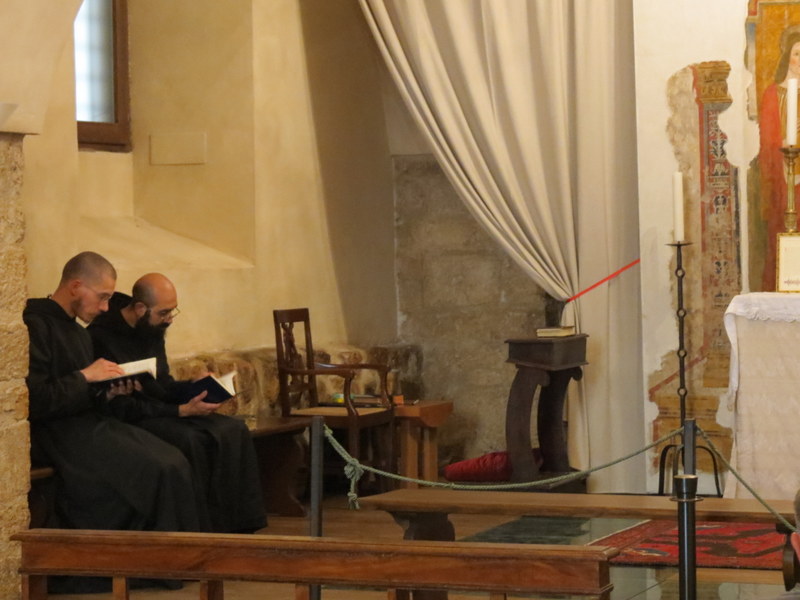
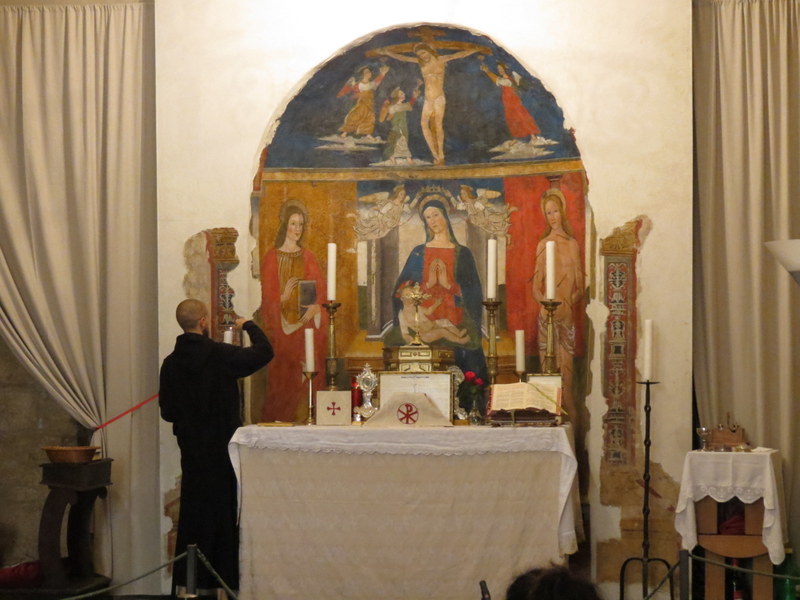
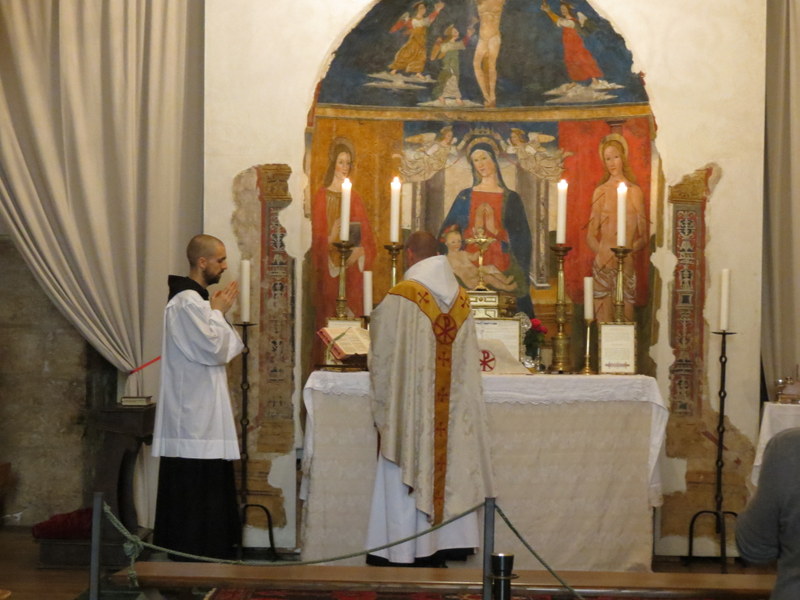
Getting ready for the first Mass in the "scavi" today.
We've more or less just been waiting for the town engineers to tell the monks which parts of the monastery and church can be used, and today the first conventual Mass was celebrated in the "scavi," the little room that has been built over the excavated remains of St. Benedict and St. Scholastica's family home. ("ExCAVation"... get it?)
Fr. Basil told us after that "very soon" they were hoping to be able to have Vespers in that space. Slowly, slowly, things are coming back to life.
V. beautiful medieval frescoes, salvaged from another Umbrian church. Put to their proper devotional use.
Fr. Cassian intones the Gospel.
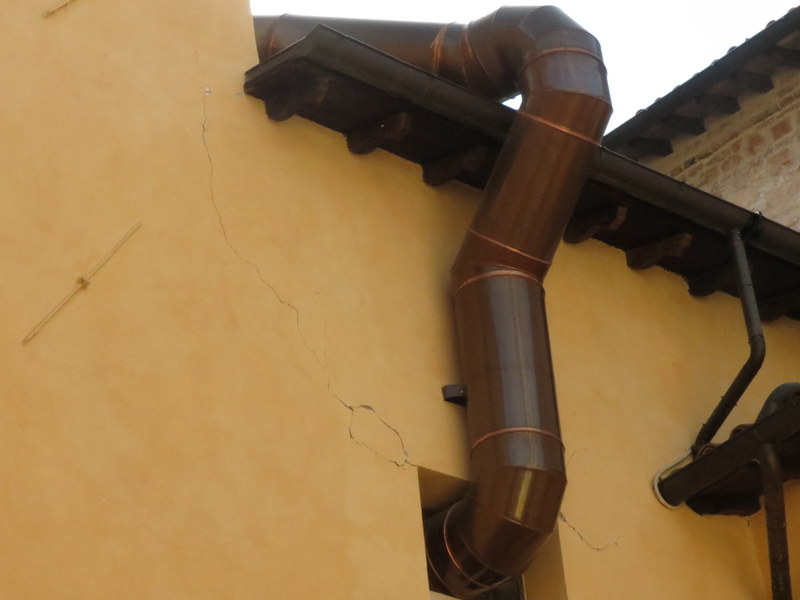
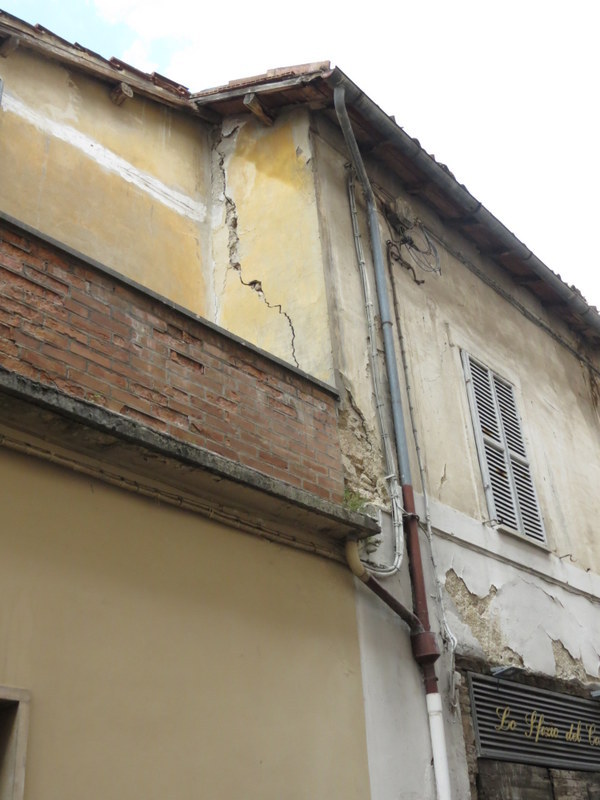
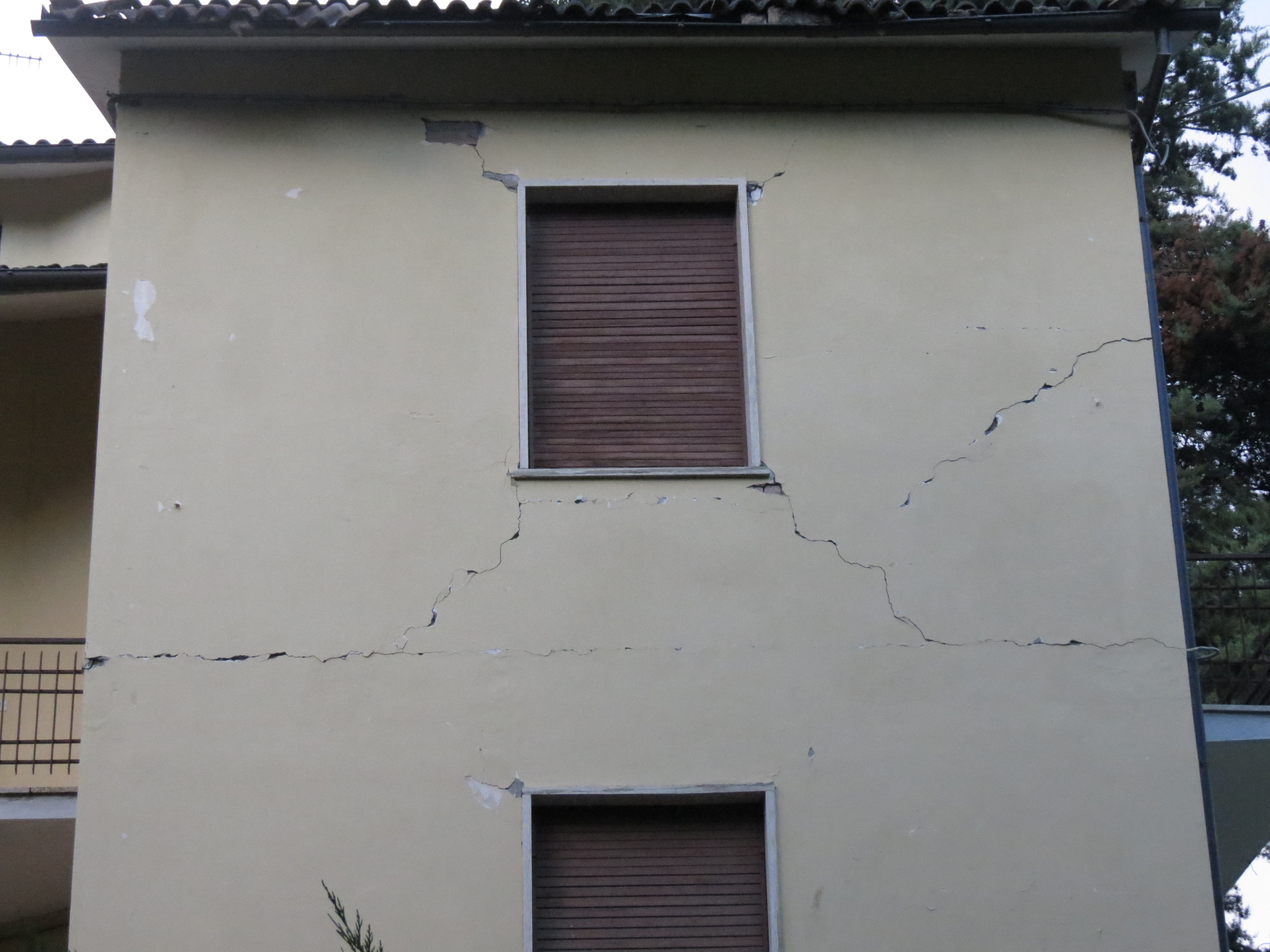
What "major structural damage" looks like in a building that hasn't fallen down. It's the wall of the kitchen of the monastery. This sort of cracking is something you can see in nearly every building in the city, and is especially dangerous since it can't be predicted how much it will take to bring the structure down. Another aftershock? Or just regular vehicle traffic over time? Who knows.
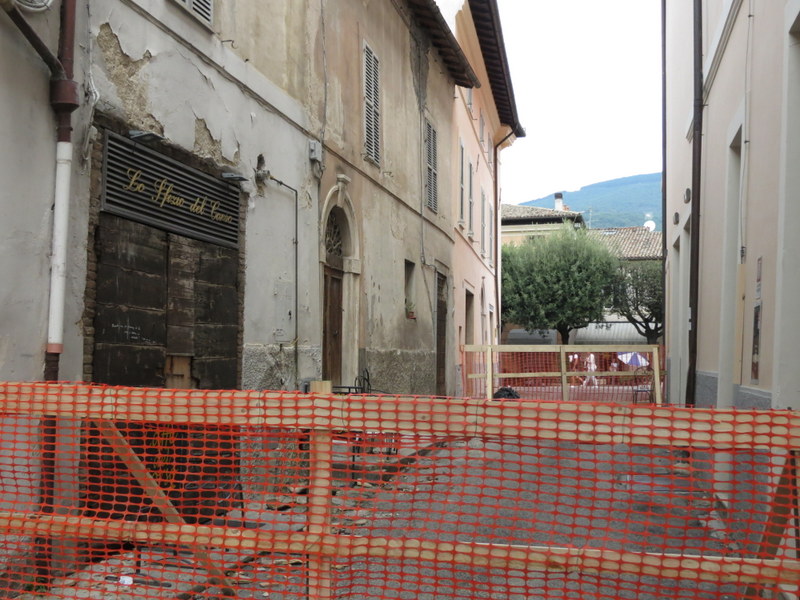
This is the back end of a row of buildings on the main street. The front of the building doesn't show any sign of damage at all, but the engineers have closed it completely, even to foot traffic. The second door on the left side is the back door to the pastry shop owned by some friends of mine who are now not able to go back to work.
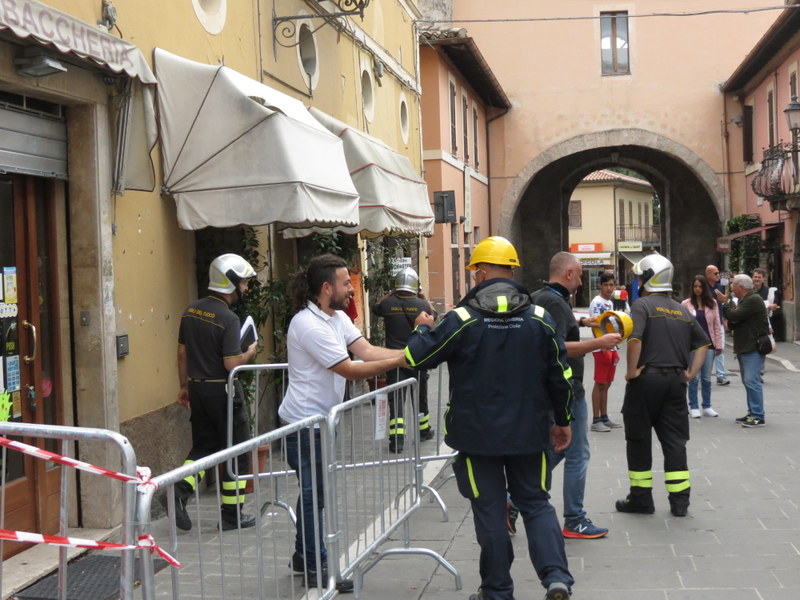
Here are the engineers from the vigili del fuoco, doing their work of systematically checking all the buildings in the city for damage.
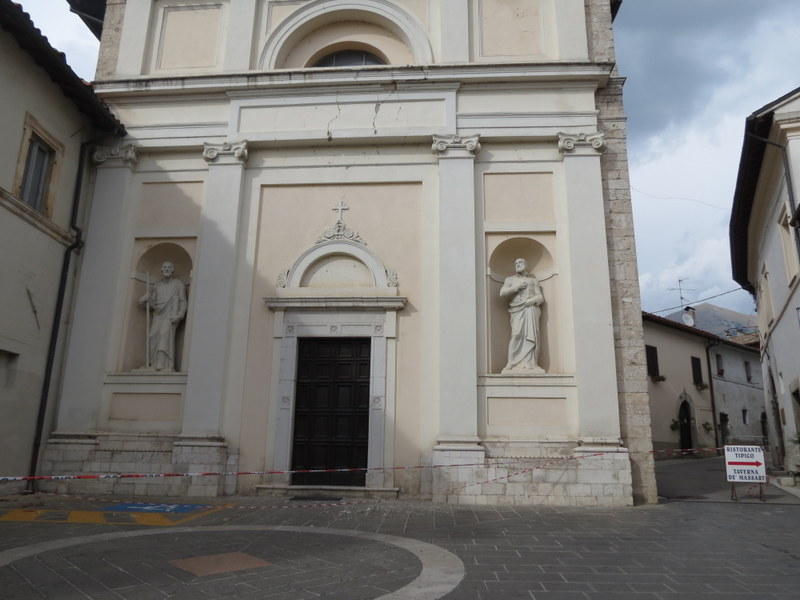
Santa Maria Addolorata, the old church of the Oratory of St. Philip Neri. You can see the big structural cracks above the doors.
Now the Ministry of Justice building, formerly the palazzo of the Knights of Malta and before that, the Oratory of St. Philip Neri.
The Basilica of Sts. Benedict and Scholastica, closed for who knows how long. You can just see the finial on the top right where it has "danced" around 45 degrees. It's made of stone and is about twice the height of a man, so that was some earthquake!
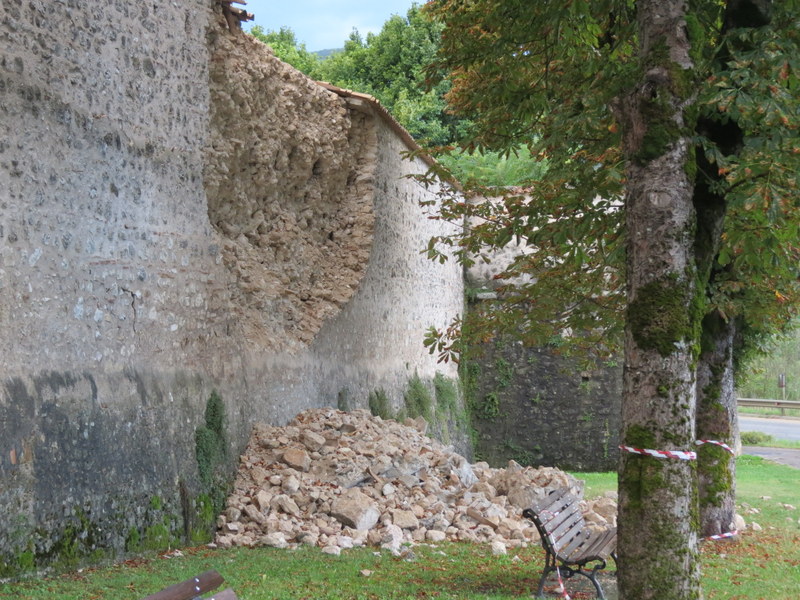
Like a giant has come along and taken a big bite out of it, and left the crumbs.
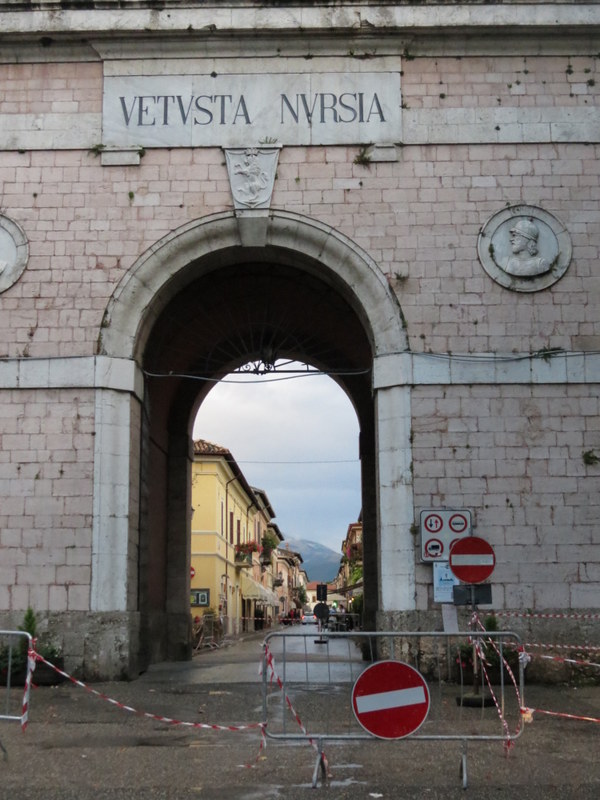
One of the two main gates into the city. Closed now to all vehicles. You can still walk through the side gate
.
Lots and lots of this.
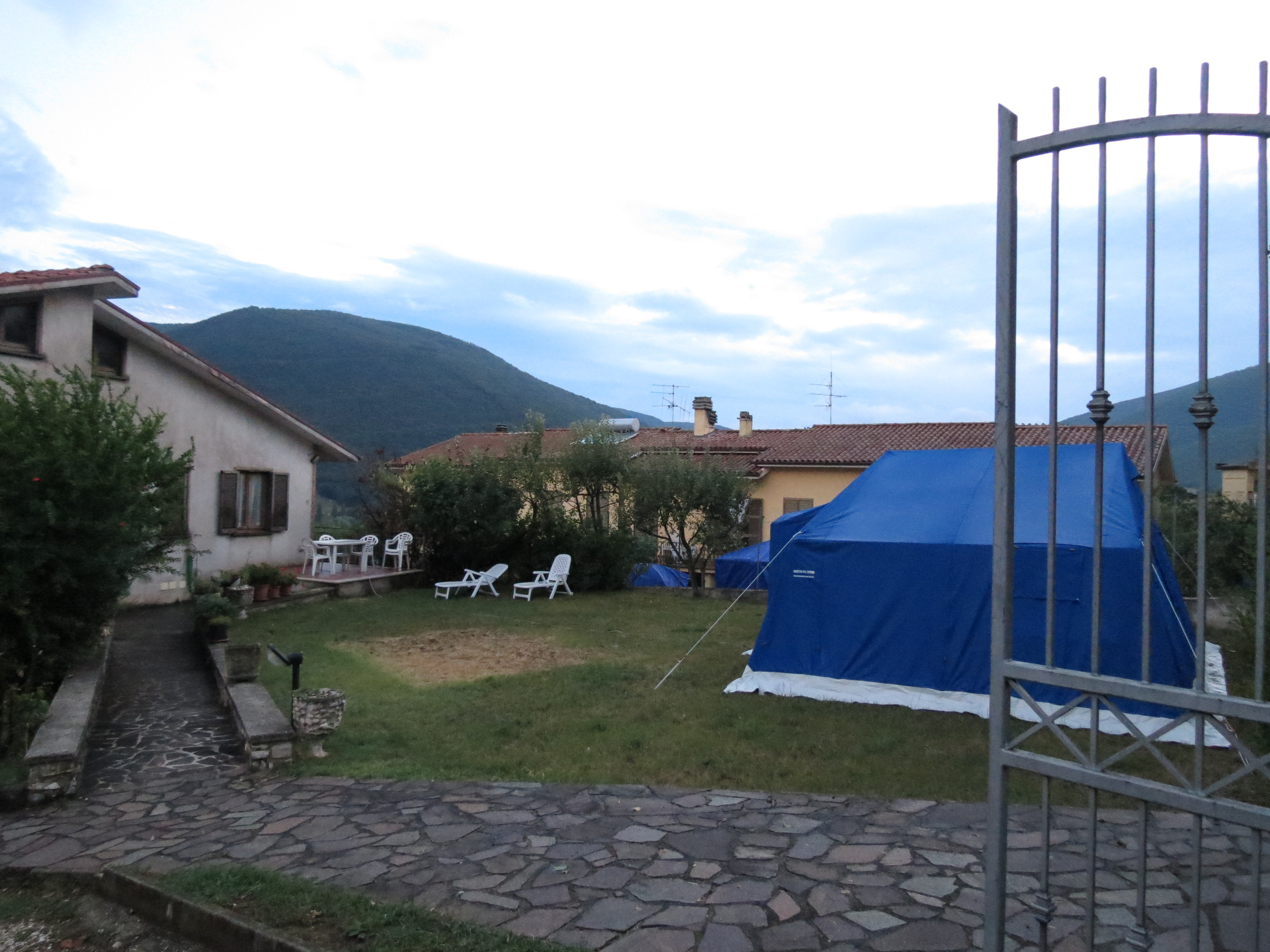
If you can't live in your house, the government will give you one of these.
Just waiting. It's what most of us are doing. Waiting to see if they can go home. Waiting to see if their house is declared safe. Waiting to find out if the insurance will cover you. Waiting to see if the government will offer re-building costs.
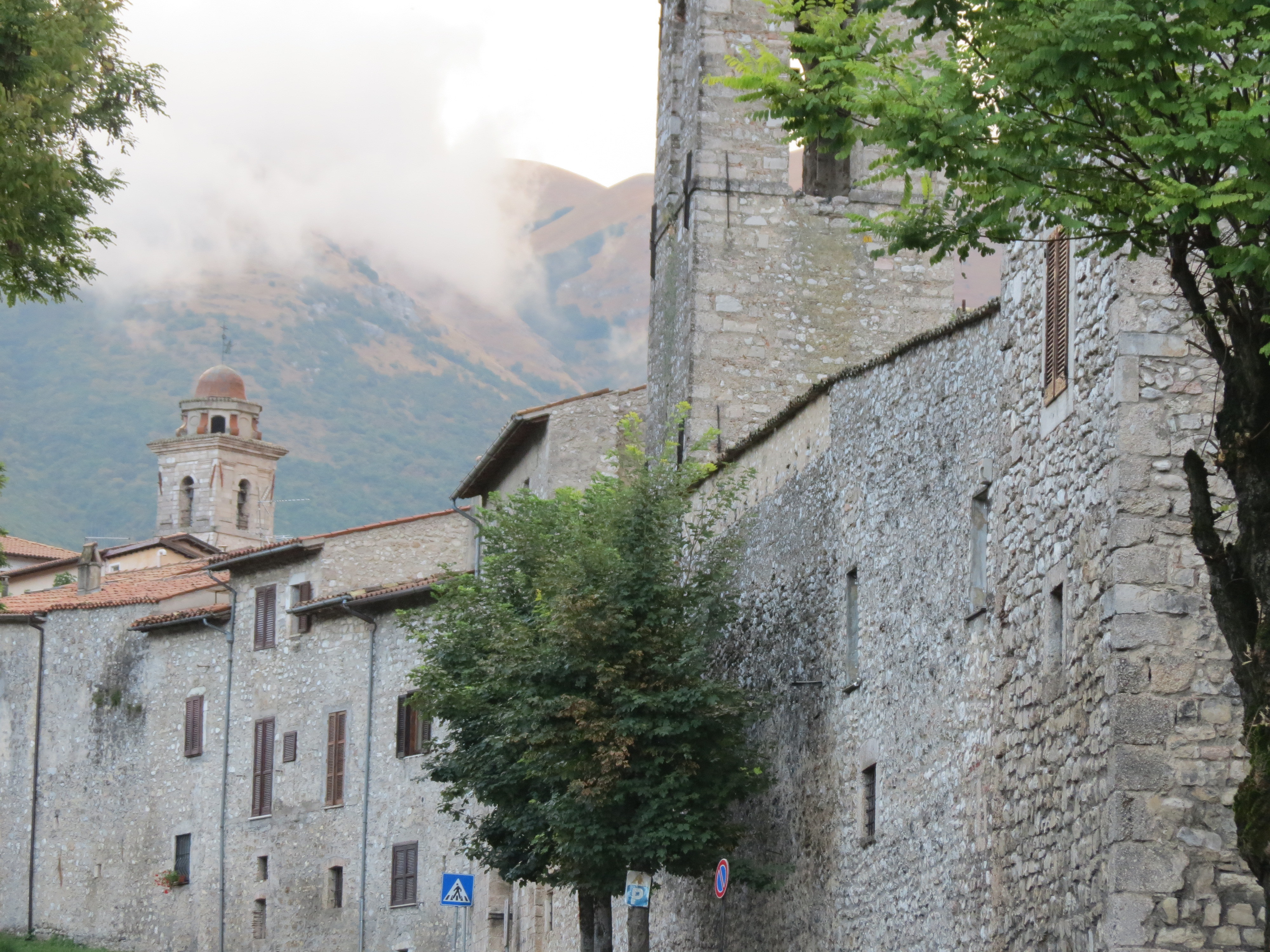
Looks as peaceful as ever.
About a block from my house. This neighbourhood didn't do too badly but some houses were not built to meet earthquake standards, despite regulations. Now everyone knows which ones.
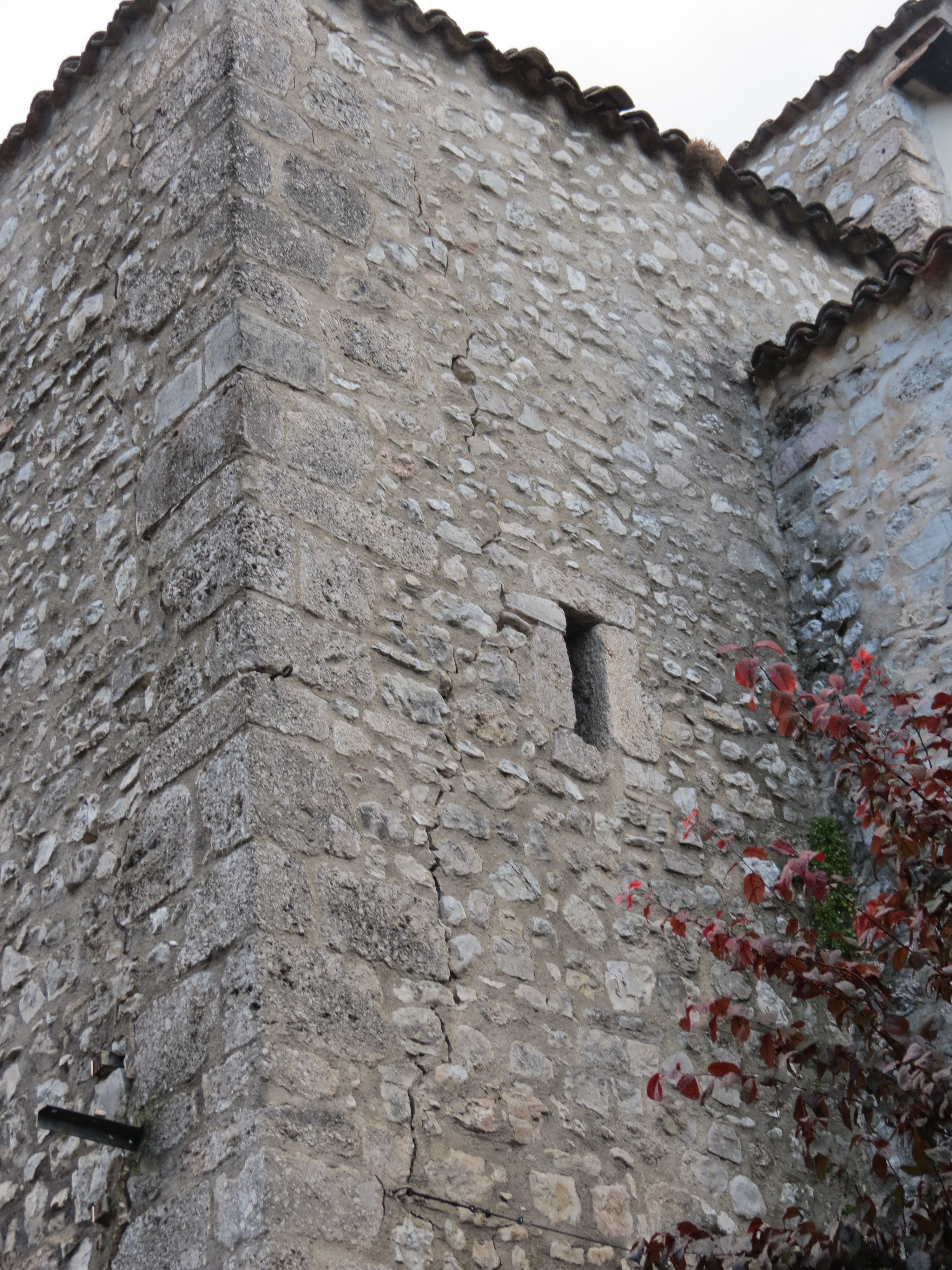
One of the medieval towers on the wall near the Rome gate. The big crack you can see running up means the whole thing could come down at any time.
I've been saving a big collection of photos from various adventures, but mostly of the garden and the local wildflowers and scenery.
Bertie and Henry, chillin'
Kitties.
The hills behind my house. Storm's coming.
Norcia.
First snapdragons. These flowered all summer.
Garden adventures and experiments.
Poppies, self-seeded from last spring.
Wild gardening.
Pippy loves to help Mummy in the garden.
He's a real mama's cat. Ever since I rescued him from the fence he got his head stuck in, I think he considers the outside world just a little too scary.
I don't make him wear it. He insists, whenever we're talking about... that stuff...
Beer, proscuitto and the garden.
Sweet little bladder campions. All finished now, and the seeds spreading for next year.
Wildflowers everywhere, and I'm recording their progress through the seasons. Later the garden came out all over in little purple harebells, and after that, with wild garlic and white scabious that the butterflies loved.
When I finally managed to make the hired "gardener" stop mowing all my flowers and ruining the soil, these little pink convolvulus spread everywhere. They died off in the really hot dry weather, but are already starting to make a second appearance.
In Italy, everything more or less dies off in the hottest, driest parts of the summer, and then the autumn rains start and we have our "second spring."
Poppies on my upper slope. Not much soil up there, so now that it's not being mowed, it will take a while to recover. But poppies are self-seeding, so we should have lots more in the spring.
I kept a careful record of what was growing up there through the spring and summer. We have figs, wild thyme, wild garlic and onions and all manner of beautiful birds and butterflies.
Henry; king of the ninja-cats.
And an oak tree the kitties love.
But Mum! It's already dead! Yes, Henry, but I still don't want it on the carpet.
Henry loves to bring me his little prizes. I put this one in the garden.
My first roses this spring. The roses had a hard year. Way too much rain in spring gave three of them fungal infections. But this one survived, and is finally producing again.
My poor roses. I had six, and am down to two. I'll have to do some reading.
Summer truffles. I found three large ones growing in the compost heap. The spores are everywhere around here, and they grow best on oak leaf litter, which was what was mostly in the compost pile.
The summer truffles have what the Italians call a "delicato" flavour, which to me means nearly totally tasteless. I'm hoping for more in the winter though, which are wonderful.
One of our annual medieval festas. They practice all year and take a great deal of pride in it.
They're the craziest, most obstinate, hidebound and parochial people on earth, and they can drive you mad with their lack of logic and determination to do things only one way, even if it doesn't work.
But they've got the best hearts in the world, will give you their own shirt and force you to have dinner with them while you're wearing it.
After many years, I've learned that the way they do things is actually almost always the better way. Once you've managed to divest yourself of your Anglo-saxon/germanic utilitarian mindset, you realise that the Italians were right all along, and when you tell them that, they'll laugh out loud and invite you for a drink.
Dear Lord, please don't ever make me live anywhere else, ever again.
It was the noise. I've never in my life heard such a horrifying noise. It was so loud, I thought for a moment that my worst child-of-the-Cold War nightmares had come true, but then I realized there had been no flash. It took me another second - while this appalling roar was still getting louder - to realize it was an earthquake, and probably a really big one. I curled up into a ball with my arms over my head and prayed the roof didn't collapse on me. I thought of the kitties, and then the monks and then my good friend who also lives in the centro. But there was nothing to do but hope I didn't die.
The first really big shock was over in a minute, (a very, very, very long minute) and I got up, shaking, and went around the house. Checked on the kitties (who sleep in their kitty-room at night) and they were fine. Pippy blinked sleepily at me, obviously wondering why I was turning on the lights at that hour. (At the first aftershock, while the house waved back and forth like a ship in the wind, he stuck out all his fur and dove under the covers.)
No damage visible in the house. A few things fell off the shelves and the pictures were askew. The power was still on and a glance out the window told me it was still going throughout the valley.
I started calling people, but realized at that moment that my phone was out of credit. Couldn't even send a text.
I decided to get dressed and go down to town to see if there was anything I could do. To see if everyone was OK. And maybe pray with the monks. While I was dressing we had our first big aftershock. All I could do was wait it out, while the house rocked back and forth and the roar, like the world collapsing, grew and then faded.
By the time I was ready at quarter to four, I heard cars and motorini already heading down the hill to town. I got on my bike at ten to four and everyone was up along my street. People were in their gardens and congregated in clutches along the roads, frightened faces shining white in the street lights.
There was already a traffic jam to get into the city at the Porta Romana, and that was where I saw the first damage. The stone of the arch was sound, but a lot of the plaster was on the ground in pieces. The plaster and stucco of many of the buildings showed large cracks, and a few facing stones were in the street. I've since learned that sections of the wall on the north side have come down and are in the road. There is a large crack down one of the medieval defensive towers. The facades of some of the churches are cracked. I'll have a walk around town later to see for myself.
But generally, the older the house, the better it held up. My friend's house in town, where I'm using her wifi, was built originally as a monastery in the 15th century and there's not a single crack anywhere, and only a few broken glasses on the floor. Houses built in the 20th and 21st centuries range from visibly damaged to uninhabitable.
The piazza was full of a couple hundred people, milling about, some with blankets around their shoulders, many with their dogs. Some older people were in wheel chairs and some of the hotel guests had their luggage piled up around them.
The monks were all there, all present and accounted for. The joke was immediately made, "So, this is what it takes to get Hilary up in time for Matins!" Hilarious, guys.
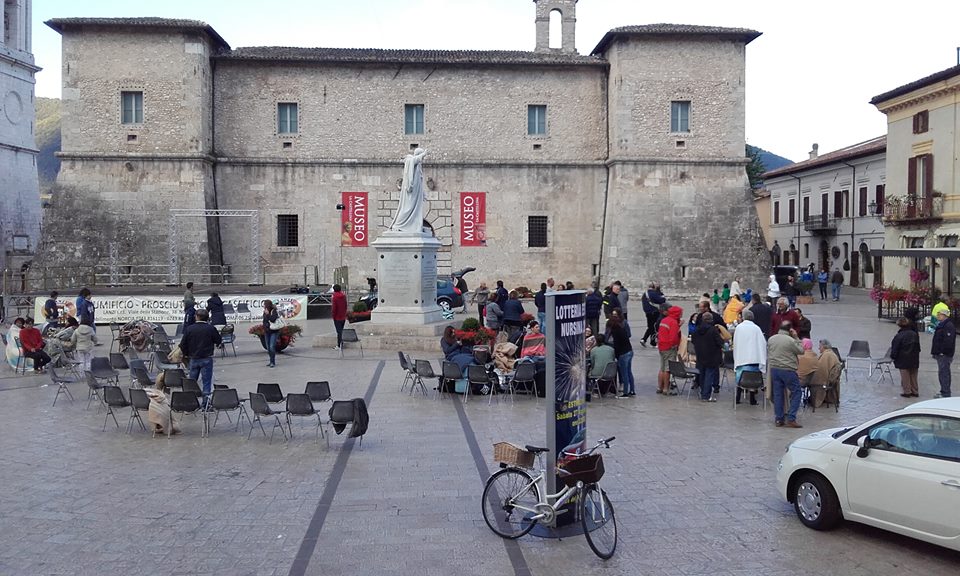
About seven am. Most of the crowd dispersed, monks (and me) singing Laudes in the crypt. Photo: Michele Sanvico, via Facebook.
I parked my bike in the piazza this morning, and not in its usual spot between the wall of the Basilica and the monks' shop. Didn't want any rocks to fall on it.
Fr. Cassian told me that no one was hurt, but the monastery was damaged and there was "quite a lot of damage in the church."
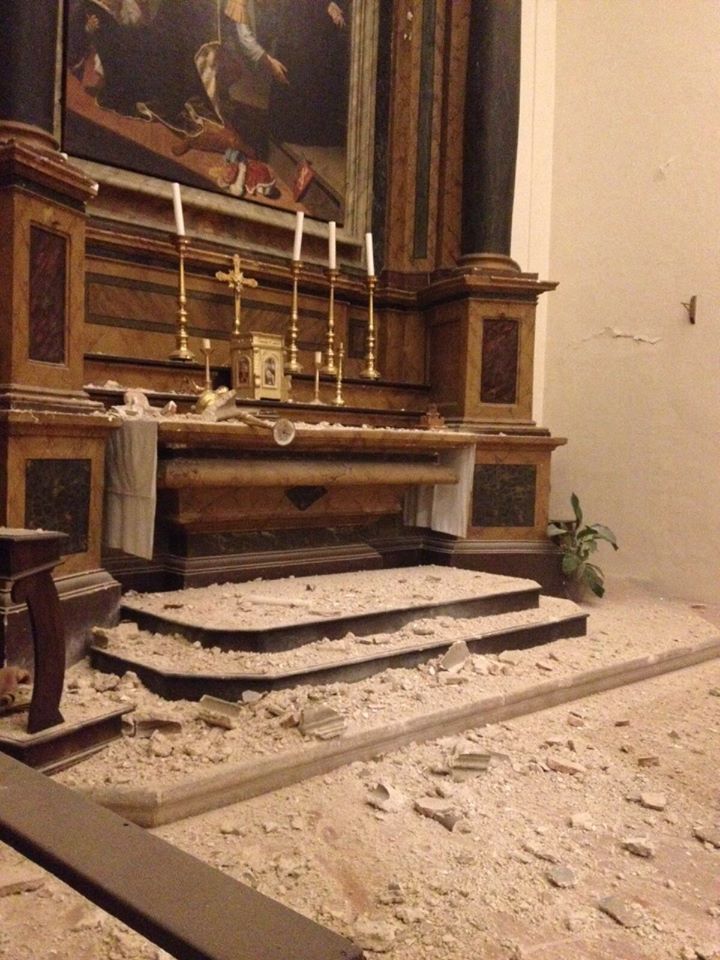
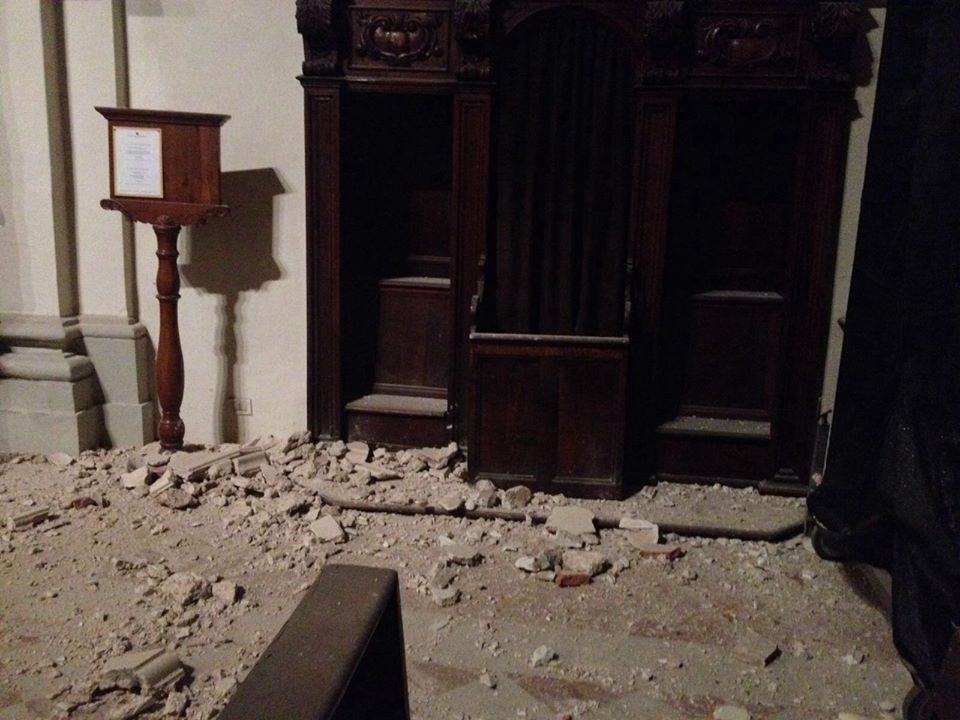
Above the painting, the whole section of decorative plaster, including an icon, is what's all over the floor. (Not my photo. Taken by one of the monastery guests. When I find out, I'll credit.)
Later, we ventured inside and saw that the Baroque-era plaster work over the St. Benedict transept altar was on the floor. (Never liked it much anyway.)
Mostly ceiling plaster
In fact, quite a lot of the ceiling plaster is on the floor too. Our ceiling is undecorated, so no art was destroyed, and all the paintings on canvas seem fine, but there's going to be a job of work to tidy up and I'm sure we've lost a lot of the decorations. We're just hoping that the restoration work on the side altars is OK. The scaffolding covering three of them is still up and looks solid.
The gathering in the piazza had an odd air. No one was quite sure if there would be another big quake, and we milled around, chatting and making weak jokes. I was sitting on the steps of the town hall when the roar came again. People were screaming with fright as the piazza, normally very reliable and solid stone, suddenly turned into a surface more like a trampoline. We clustered in the centre of the piazza as we watched the cross and the statues on the facade of the Basilica, looming far above our heads, wave back and forth like flags.
The aftershocks have continued all day. I was just now over at a friend's place helping to sweep up broken glass, when another one came. You freeze as the rumble starts, and consider your options. Dive under the big oak dining table? Seems like a pretty good idea...
The five am tremor was the last of the big ones, though (so far) and we started to get reports from the internet on iPhones about other towns.
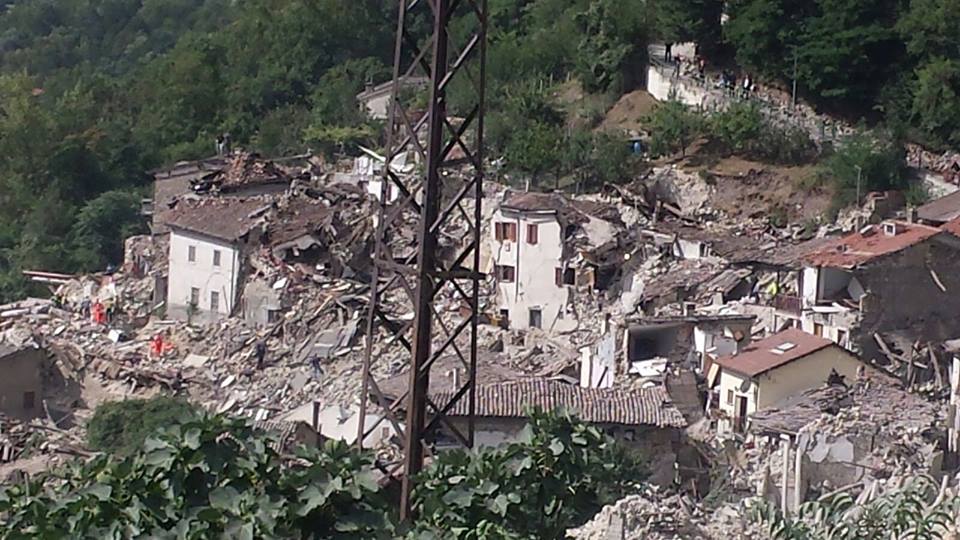
The towns of Amatrice and Accumoli were the worst, with most of these towns flattened, people dead and missing, shouts heard from under piles of rubble. The latest count from Amatrice (at eleven am) is 22 dead.
Pescara del Tronto, about a 20 minute drive from here. Foto Massimiliano Savino. Posted by RAI on FB
This is a mountainous region, with what few roads there are often winding through steep valleys with high, rocky peaks all around, so steep that in winter whole sections remain in constant shadow. The highways often drive right through the mountains and rock falls are common in winter. We have already seen photos of some of the tunnels partially collapsed. Reports have come in that emergency vehicles are having a hard time getting up to some of the smaller, more remote hill towns. Not many people still live in them, but those who do are nearly all elderly people.
As we started seeing reports of people killed - Amatrice just reported 22 dead and the town "no longer there" - we decided it was time to pray. The early hours of morning before dawn are cold, and the monks were in their hoods. Many of the local people and hotel guests had blankets wrapped around them. We all stood in a large circle as Fr. Cassian, seated on the steps at the base of St. Benedict's statue, started the prayers in Latin. A number of people joined us, young and old. A girl about seventeen was standing next to me, wrapped up in a blanket under her boyfriend's arm. Both were praying the old Latin prayers. All knelt and received the blessing after we sang the Salve Regina through another aftershock.
Some people from the city arrived in a truck and put out chairs. The hotel people came around with blankets. The chief of the Carabinieri arrived in his civies, the mayor was there with his wife. I helped hand around some pastries and fruit. We were asked to stay out of the buildings until at least 15 minutes after the last aftershock. It's nearly 11:30 and we're still getting them.
While it was still dark, but the sky was lightening, the monks and friends went to the shop to have something to eat and figure out where we were going to have Laudes. The painted plaster in the ceiling was cracked and much of it was on the floor. A few bottles were broken and we swept up the glass. Someone brought out bananas, pears, cornetti and coffee. We stood around talking and joking. It's a funny thing that though we were scared, and with fairly good reason, the mood was cheerful. The first big tremor was over, and we didn't think there would be another really big shake. We were mostly thinking about all that needed to be done to clean up and get life started again.
Fr. Cassian led the way down to the crypt church - the family home of Sts. Benedict and Scolastica - that has a sturdy vaulted ceiling and has withstood earthquakes since the 2nd century BC. It was an experience I'll not soon forget, singing the Divine Office, Laudes for the Feast of St. Bartholomew in that ancient place, the monks voices strong and deep, resonating off the stone. Not one beat was skipped as another large aftershock shook us during the Benedictus. No one even glanced up.
Afterwards, I got a call from Vatican Radio, a friend who works in the English section wanted "local colour" for their story. I might post it if I can find it and if I don't sound like too much of an idiot.
People are still pretty jumpy. Each aftershock, coming every ten or fifteen minutes, is incredibly unsettling. But the mood in town is still very cheerful. We are aware that other places near by weren't so lucky and there are people here who have gone off to help with trucks and winches and digging equipment. Meanwhile, I was glad to run into friends in the piazza who told me that all their family are fine - including their dozen-odd pets - but that their house was un-livable. They have a kind of family compound outside town in the country, right at the base of the mountain; mum and dad in one house, brother and sister-in-law in the next, and the two of them in the third. There's lots of work to be done to fix things up.
But this is Italy, and everyone knows we have earthquakes here. People will help each other, they'll sweep and tidy, and help to rebuild. They'll take each other in and make meals and look after the kids while the grownups work. It's always been this way. It always will be this way. Thank God.