Tuesday, December 13, 2011


Sunday, December 11, 2011
Brutalist by name, brutal by nature
Intelligent comment from the Adam Smith Institute on why the British Housing Estates need to be knocked down as soon as possible:
He mentions similar constructions in Italy.
I went down south with a bunch of friends last year to visit Monte Cassino and on the drive we had to go through some little towns that looked as if they had been built after the Second World War when some Italian government official decided to make the entire country into a suitable movie location for nihilist post-apocalyptic filmmaker. As a bonus, the population seemed to be practising to gain employment as zombie extras the same films.
I've never in my life seen any human dwelling more closely resembling a gargantuan garbage heap.
Scruton has quite a bit to say on the subj. Starting about 7:14
~
Opposition to post-war architecture tends to focus on aesthetic concerns. And, certainly, much of it is appalling ugly, almost to the point that merely looking at it fills you with despair. But its mostly deeply pernicious effect is surely the way in which it has affected people’s behaviour, by forcing them to live in an environment which is cold, desolate and practically inhuman. Naturally, I am not suggesting that post-war architecture caused the riots. But the idea that it was a contributory factor certainly has the ring of truth about it.
He mentions similar constructions in Italy.
Incidentally, the picture I’ve used here is not actually from a post-war London housing estate. It is a photo of the Vele di Scampia estate near Naples, which was the setting for the stunning, shocking film Gomorrah. If you’re sceptical about the social consequences of bad architecture, I’d challenge you to watch that film and, bearing in mind that it is based on real events, ask yourself whether many of the things depicted would be possible in a traditional street layout. For me, it’s a shining example of brutalist by name, brutal by nature.
I went down south with a bunch of friends last year to visit Monte Cassino and on the drive we had to go through some little towns that looked as if they had been built after the Second World War when some Italian government official decided to make the entire country into a suitable movie location for nihilist post-apocalyptic filmmaker. As a bonus, the population seemed to be practising to gain employment as zombie extras the same films.
I've never in my life seen any human dwelling more closely resembling a gargantuan garbage heap.
Scruton has quite a bit to say on the subj. Starting about 7:14
~
Lippi Exhibition

Went to see the Lippi exhibition at the Quirinale yesterday. Something the Rome-bound should know; most of the museums in town have incredible, world-class exhibitions and they're not expensive. It was ten Euros to get in to this one. You don't usually have to book tickets in advance, though this can help you to jump the queue.
The Lippi/Botticelli show at the pope's former house was, well, frankly amazing. The colours! The transparencies! The wee teeny details like the little bug eating a crust of bread, the meticulously rendered flowers so detailed you can identify the species. The faces of angels and saints glowing with otherworldly radiance. Oh. My. GOODness!
We saw

this one,
and this one


here's some details... here are the angels bigger...

and check out the books. Amazing!
and this one

and

this one...
Plus a bunch of drawings.
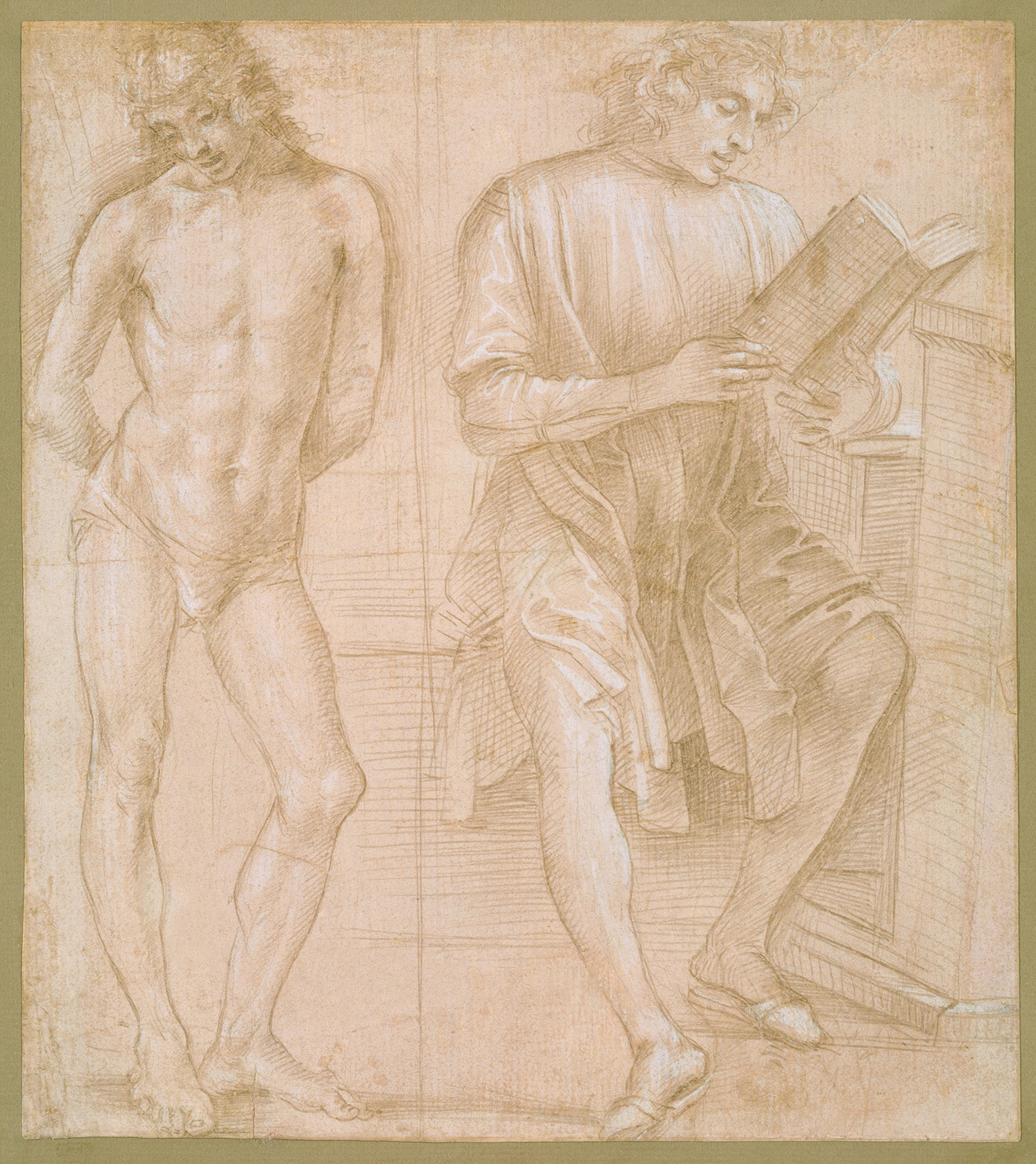
(There were a few Botticellis too, but they left me kind of.. meh...Lippi decidedly surpassed his former master.)
The colours... it's hard to describe. In fact, so much of their value is lost in reproductions, I think I might be joining the snobby school of thought that says never reproduce art in books or on the internet. There's so little point, it almost seems as if it would put people off rather than arouse interest.
A while ago, I was taken by a friend to the Borghese gallery and he knew there was a very famous work that we are all familiar with, but didn't warn me. At one point, after the Caravaggios and Raphaels and whatnot, he said, "Oh, you should go take a look in there..." I rounded the corner and there it was. I almost burst into tears. The present reality of the work was so much more than any photograph could possibly capture...

As a child, I spent hours poring over the pictures in art books, and was an early aficionado of the early Italian Renaissance artists, but living in such a remote place as British Columbia had few opportunities ever to see any real art. When I was 12, a traveling exhibition of the treasures of the tomb of King Tut came to Seattle, and my mother, though poor, was determined that I should get a chance to see it. I had of course seen any number of photographs of this, but when I cam face to face with it, I found it was almost shockingly different in reality.

When at last we got to the bookshop last night, (it was a really big show, on two floors of the gallery) we discovered that the exhibition's book, which was quite beautiful, was 40 Euros. Yikes! and since I'm a bit skint at the moment, I was going to get one of the other Lippi books. But after seeing the real thing, the reproductions just seemed so dark and colourless that I couldn't be bothered. Instead, I got a little postcard of the blue madonna, the one in the post below, and Vicky bought a poster of her head. But as I was looking at the paintings and thinking about how badly I wanted one, it became obvious that the only thing to do is to learn to make one.
All the big paintings were tempera on wood, a medium that gives utterly glowing colours. I don't know who teaches tempera, but as soon as I'm at a place where Andrea thinks I'm ready, I'm going to find someone who does it.
Towards the end of the first floor of the exhibition, Vicky stopped to draw the only statue in the show. I spend the time wandering back and forth taking mental pictures of the best bits of the best ones, a strange skill that I invented for myself after seeing the Tut exhibit. I have several images in my head now, of folds of glowing cloth, of almost invisible transparent draperies, of minutely rendered wrinkles on fingers, that I hope will stay in there forever.
I walked up and down in this room of wonders and thought, this makes me happy, like nothing else but love ever has.
~
Friday, December 09, 2011
Note to self

Do something normal this weekend, pretend that life is going ahead and that everything will turn out OK.
Go see that Lippi exhibition at the Quirinale.
~
Thursday, December 08, 2011
Do they hear themselves?
Just reading some of the pro-aborts little outbursts on why abortion in the US has to remain totally unrestricted.
Let's play a game! I'm going to paraphrase some of the real things real famous pro-abortion people have said in public and we can do a little deconstruction excercise. Come on! It'll be fun.
A white male rock star:
Translate:
1) My career is more important to me than human life, even the life of my own child. It is much more important to me to fulfill my personal jet-setting ambitions than be responsible for the care and protection of another human being.
2) Even though I am the lead of one of the world's most highly paid acts, I'm still unable to adequately support a child. By extension, I believe that anyone who makes less money than I should also not have children. Only the super rich should be allowed to have children because material poverty, which I define as being less than super rich, is worse than death.
3) The definition of being free is the freedom to kill another person with legal impunity whenever we want.
4) It is better for the poor that they be killed before birth than attend a public school or be dependent upon state benefits. Kill the poor.
* ~ *
A black Rap star: "Gold-digging women use pregnancy to trap rich men into either supporting them or paying for expensive abortions. Use condoms to prevent pregnancies."
Translate:
Legal abortion is not for the safeguarding of the rights of women, it is to enable men to use them for sexual entertainment without consequences. But abortion can be more expensive than you realise, so in order to continue to use women as your own personal meat puppets, you should diligently use contraception.
* ~ *
Some kind of presenter (female, white) on MTV: "I am glad I had an abortion at 16, otherwise I would by now have a 20 year-old child.”
Translate:
Being a mother is bad. Being a mother of a child who is a grownup would reveal that I'm old enough to have a 20 year-old child. And that would be bad.
* ~ *
What am I demonstrating here? That celebrities are shallow, selfish and materialistic? And stupid? Isn't that something we all know already?
So if we all know this, why do we hang on their every word? Why do the idiotic and frankly evil things that come out of their mouths subsequently pop out of the mouths of the ordinary 17 year-old kids who follow them?
I feel a bout of cultural cognitive dissonance coming on...
~
Let's play a game! I'm going to paraphrase some of the real things real famous pro-abortion people have said in public and we can do a little deconstruction excercise. Come on! It'll be fun.
A white male rock star:
"1) If abortion had been illegal when my girlfriend became pregnant, I would not be in the position I'm in. My career would have been stalled at the outset. I would not have been able to tour around the world and see how other more liberal countries have handled this issue. I would not be speaking to you (the interviewer) today.
2) Maybe later I'll be able to support a child.
3) But free people must have the right to choose when the right time is.
4) This rule especially applies to poor people since welfare and public health programmes are inadequate to raise a child and public schools are overcrowded and underfunded."
Translate:
1) My career is more important to me than human life, even the life of my own child. It is much more important to me to fulfill my personal jet-setting ambitions than be responsible for the care and protection of another human being.
2) Even though I am the lead of one of the world's most highly paid acts, I'm still unable to adequately support a child. By extension, I believe that anyone who makes less money than I should also not have children. Only the super rich should be allowed to have children because material poverty, which I define as being less than super rich, is worse than death.
3) The definition of being free is the freedom to kill another person with legal impunity whenever we want.
4) It is better for the poor that they be killed before birth than attend a public school or be dependent upon state benefits. Kill the poor.
* ~ *
A black Rap star: "Gold-digging women use pregnancy to trap rich men into either supporting them or paying for expensive abortions. Use condoms to prevent pregnancies."
Translate:
Legal abortion is not for the safeguarding of the rights of women, it is to enable men to use them for sexual entertainment without consequences. But abortion can be more expensive than you realise, so in order to continue to use women as your own personal meat puppets, you should diligently use contraception.
* ~ *
Some kind of presenter (female, white) on MTV: "I am glad I had an abortion at 16, otherwise I would by now have a 20 year-old child.”
Translate:
Being a mother is bad. Being a mother of a child who is a grownup would reveal that I'm old enough to have a 20 year-old child. And that would be bad.
* ~ *
What am I demonstrating here? That celebrities are shallow, selfish and materialistic? And stupid? Isn't that something we all know already?
So if we all know this, why do we hang on their every word? Why do the idiotic and frankly evil things that come out of their mouths subsequently pop out of the mouths of the ordinary 17 year-old kids who follow them?
I feel a bout of cultural cognitive dissonance coming on...
~
Wednesday, December 07, 2011
A prayer
Learned this week that I'm still sick. Really sick.
Tried to get back to life a bit and go to art class this week but just couldn't manage it. Andrea's studio, in an important and historic 16th century building close to the Piazza del Popolo is also at the bottom of a kind of transit sink hole. The easiest and fastest way to get there is to take the train to San Pietro station and either hoof it across the Big Piazza and cross the river on the Ponte Cavour, or you can take a bus from the stazione down the hill, past the big dome and over the river and walk through the little windey streets from the bus loop near the Angel bridge.
Either way its a good brisk 20 or 30 minute walk, and invariably no matter how cool the weather is I am drenched with sweat and out of breath by the time I get there. I usually have a little ten-minute sit-down on the studio terrace and a glass of water before starting and am OK, but this Monday I just couldn't get untired. But since Andrea is going away for a few months and this will be the last chance I get for a while, I thought it would be silly to just turn around and go home again.
Besides, I'd brought my computer with me and had the ambition to go to the office and get some work done after class. It's been so long since I've had a normal day, I just really wanted a smidgen of my regular life. But it didn't work out.
In class, we stand in front of the easel about two arms lengths away and the technique involves taking a measurement from that distance and then walking the step or two forward to make the mark on the paper. Classes are three hours and it can be pretty tiring. By the end of it, I usually am pretty happy to sit down at my desk for the rest of the day.
But this week it really became clear how much the chemo has taken out of me. It looks too as if the poison drugs have damaged my ovaries, and I've been having rather severe symptoms of premature menopause. This means a constant undulation: hot/cold/hot/cold/hot/cold. Overwhelming heat, sweat pouring off me, red faced and panting and five minutes later shivering and chilled. This amusing routine going on about three or four times an hour, 24 hours a day. The preamble of nausea, dizziness and heart palpitations lets me know when one is coming on. Stress brings it on and as you may imagine, it makes it rather harder than usual to concentrate.
The neuropathy is aggravated by being tired and by the end of two hours of class, my feet were on fire, with pain spreading up my legs. The pain of neuropathy is multifaceted, and a big part of it is the feeling that one's toes and fingers are swelling up and getting ready to explode. When it's bad, touching anything hard, like turning a key in a lock or winding a clock, feels like your fingers have a "funny bone" in them, all the nerves cringe together as though getting an electric shock. Some days holding the pencil is a bit of work by itself.
Despite all this, and despite it making me a little cranky and ill-humoured, I got to the end of class, but was a bit of a wreck. After, I had to do a couple of little chores, cutting up some large sheets of paper so I could get them home in my folder. But before doing that, I ran out to the farmacia to buy some paracetomol, known in the US as extra strength Tylenol, to back up the drugs that were obviously not up to the task that day. We're still working on adjusting the new pain meds, with too much turning me into a zombie and too little leaving me in pain by mid afternoon. It works pretty well if I'm not doing too much in the day. And some days, for no particular reason the whole thing just flares up. The doctor said if the meds stop working too soon, I can back them up with paracetomol, but it doesn't work terribly well.
When I was getting ready to go home, Andrea said, "So, on a scale of one to ten, how much pain are you in?" About six, maybe six and a half. Not screaming agony by any means, but bad enough to make everything no fun at all.
Bit of a mess, is the long and the short of it and this week it all kind of came to a head.
So Monday afternoon, I was done in by two o'clock and just had to go home. Hot/cold flashes every fifteen minutes notwithstanding, I was falling asleep on the train and went to bed more or less instantly after getting home. On Tuesday morning, it really hit me just how sick I'd got. Up only for a few hours in the morning for a cup of tea; back to bed by two-thirty. Up for a while in the evening, and me n' Vick watched the Fellowship of the Ring. Had some dinner and went back to bed. When you're spaced out and sick, in pain and on narcotic meds, the day just sort of floats by in a kind of weird droopy haze.
A day in bed, though, did me a world of good and this morning I had enough perk to go to the doctor and report that things are really not going terribly well. The good news is that my local GP is really terrific and has been a huge support in all this awfulness. He is setting me up with an oncologist who speaks English and will be able to tell me what's going on. I can get the Gemelli to give him my medical records and he can explain things and keep a closer eye on me and my doings than the staff at the hospital can. Obviously I should have done this months ago, but I was mostly expecting to be starting to recover by now. I'm only just now learning that chemo often doesn't work that way, new symptoms and side effects can appear months and sometimes even years after the last cycle is over. Something I'd have known about if the Gemelli doctors were as interested in keeping me informed as they are in doctoring me... it's been a bit of a bone of contention so far.
My appointment this morning did a lot to put my mind at ease. Things are going to get worked out. The things that are happening now are debilitating and awful, but not life threatening and can be treated successfully. They're going to go away and be under control. Things are going to get worked out.
I left the doctor's office and walked out into the late morning sunshine. In early December it's a beautiful warm, breezy autumnal day, absolutely perfect. Cool air, warm sun, nice little breeze off the sea bringing in sweet damp that's just like home. The autumn rains that started this year quite late, in November, have given us our annual "second spring," with all the grass that goes brown and sere in our ferocious summers, coming up again green and soft, flowers nodding over the tops of garden walls, happy children kicking the soccer ball around in the school yard.
I came out of the office and was still woozy and wobbly, but quite a bit mended and didn't want to go straight home. I took a slow walk up the Via Aurelia, the Roman road that runs through the centro of S. Marinella, and ended up going down to the castle and the marina. There's a promontory there, where, on a clear day, with your back to the old Odescalchi castle, you can see nearly all the way down to Rome, with the other castle at Santa Severa gleaming in the sun, a stern old fortress warding off marauding Saracen pirates.
Behind the castle, that is built on top of the foundations of a Roman senator's country villa, there is another little beach, hidden from the great running of the Rome tourists in the summer, with patches of black volcanic sand, big bulges of sandstone coming out of the ground all weathered into undulating Art Nouveau shapes, and logs to lean your back against. Just like home. This beach is on a little cove and is sheltered from the wind and only a few beautiful white neoclassical villas nestling in the shrubbery and trees on the hill.
I sat down on the sand and turned my face into the breeze and just breathed. It felt like the first time in days.
I'm scheduled to have surgery next week. I am hoping to get a consultation with this new oncologist before then. I know the Gemelli doctors know what they're doing and I'm pretty confident that the surgery will be the end of the cancer. I am also growing in confidence that the difficulties the surgery will create can be dealt with.
Things are pretty hopeful, but I've been terribly afraid. Cancer is unpredictable, and no one can possibly say for sure if all this is going to work. The news about the micrometastases in the margins after the last surgery has really shaken me. I'm deeply frightened by the thought that this might mean the cancer is anywhere and there is no way to tell until it is too late.
I've been praying for a lot of things but, and this might surprise you, I have yet to simply ask to be delivered from cancer. For the treatment to work.
I walked along this little hidden beach and finally knew that I really wanted to live. At least for a few more years.
"Lord, I'd just like to ask if I can please get past this and live for a while longer. I am OK with it if you have other plans, but I'd just like to get it out there.
"Things are really nice right now, and maybe for the first time. I've got such good work, and such nice friends and I've finally figured out for the most part how to get on in life. And honestly, I'd really just like to enjoy it for a bit, if that's OK.
"I think I can handle the long term consequences of the surgery and still have a bit of a nice life. I don't even mind if things are a little reduced in scale from now on. I can deal with living a little smaller and a little slower. But I think I've got a chance to be happy for a while and I'd like to try it."
I've been getting a lot of messages via email and Facebook in response to my last few Meaning of Life posts and I'd like to let y'all know that it has actually been really helpful, so thanks. I know that a great many of you have been praying (some have even paid money to get large numbers of other people to pray too, entire convents of nuns) so I thought I'd let you know that I'm getting to a sort of peace with the whole thing.
Don't get me wrong; I certainly have my little screeching moments of mindless panic, but they're fewer, shorter and easier to stop now, even without the application of the frying pan to the head. It might surprise some to know that the whole cancer experience has in many ways been beneficial. As a news writer, I know how important a deadline can be to your productivity. The saints and famous spiritual writers always say the same thing: keep your eye fixed on the reality of death. And cancer certainly has a way of making that impossible to avoid.
I'm finding my way through it. Maybe in a somewhat muddled and inefficient way, but I'm getting there and it is in no small part due to the support I've had from friends, readers and colleagues.
Thanks.
Again.
~
Tried to get back to life a bit and go to art class this week but just couldn't manage it. Andrea's studio, in an important and historic 16th century building close to the Piazza del Popolo is also at the bottom of a kind of transit sink hole. The easiest and fastest way to get there is to take the train to San Pietro station and either hoof it across the Big Piazza and cross the river on the Ponte Cavour, or you can take a bus from the stazione down the hill, past the big dome and over the river and walk through the little windey streets from the bus loop near the Angel bridge.
Either way its a good brisk 20 or 30 minute walk, and invariably no matter how cool the weather is I am drenched with sweat and out of breath by the time I get there. I usually have a little ten-minute sit-down on the studio terrace and a glass of water before starting and am OK, but this Monday I just couldn't get untired. But since Andrea is going away for a few months and this will be the last chance I get for a while, I thought it would be silly to just turn around and go home again.
Besides, I'd brought my computer with me and had the ambition to go to the office and get some work done after class. It's been so long since I've had a normal day, I just really wanted a smidgen of my regular life. But it didn't work out.
In class, we stand in front of the easel about two arms lengths away and the technique involves taking a measurement from that distance and then walking the step or two forward to make the mark on the paper. Classes are three hours and it can be pretty tiring. By the end of it, I usually am pretty happy to sit down at my desk for the rest of the day.
But this week it really became clear how much the chemo has taken out of me. It looks too as if the poison drugs have damaged my ovaries, and I've been having rather severe symptoms of premature menopause. This means a constant undulation: hot/cold/hot/cold/hot/cold. Overwhelming heat, sweat pouring off me, red faced and panting and five minutes later shivering and chilled. This amusing routine going on about three or four times an hour, 24 hours a day. The preamble of nausea, dizziness and heart palpitations lets me know when one is coming on. Stress brings it on and as you may imagine, it makes it rather harder than usual to concentrate.
The neuropathy is aggravated by being tired and by the end of two hours of class, my feet were on fire, with pain spreading up my legs. The pain of neuropathy is multifaceted, and a big part of it is the feeling that one's toes and fingers are swelling up and getting ready to explode. When it's bad, touching anything hard, like turning a key in a lock or winding a clock, feels like your fingers have a "funny bone" in them, all the nerves cringe together as though getting an electric shock. Some days holding the pencil is a bit of work by itself.
Despite all this, and despite it making me a little cranky and ill-humoured, I got to the end of class, but was a bit of a wreck. After, I had to do a couple of little chores, cutting up some large sheets of paper so I could get them home in my folder. But before doing that, I ran out to the farmacia to buy some paracetomol, known in the US as extra strength Tylenol, to back up the drugs that were obviously not up to the task that day. We're still working on adjusting the new pain meds, with too much turning me into a zombie and too little leaving me in pain by mid afternoon. It works pretty well if I'm not doing too much in the day. And some days, for no particular reason the whole thing just flares up. The doctor said if the meds stop working too soon, I can back them up with paracetomol, but it doesn't work terribly well.
When I was getting ready to go home, Andrea said, "So, on a scale of one to ten, how much pain are you in?" About six, maybe six and a half. Not screaming agony by any means, but bad enough to make everything no fun at all.
Bit of a mess, is the long and the short of it and this week it all kind of came to a head.
So Monday afternoon, I was done in by two o'clock and just had to go home. Hot/cold flashes every fifteen minutes notwithstanding, I was falling asleep on the train and went to bed more or less instantly after getting home. On Tuesday morning, it really hit me just how sick I'd got. Up only for a few hours in the morning for a cup of tea; back to bed by two-thirty. Up for a while in the evening, and me n' Vick watched the Fellowship of the Ring. Had some dinner and went back to bed. When you're spaced out and sick, in pain and on narcotic meds, the day just sort of floats by in a kind of weird droopy haze.
A day in bed, though, did me a world of good and this morning I had enough perk to go to the doctor and report that things are really not going terribly well. The good news is that my local GP is really terrific and has been a huge support in all this awfulness. He is setting me up with an oncologist who speaks English and will be able to tell me what's going on. I can get the Gemelli to give him my medical records and he can explain things and keep a closer eye on me and my doings than the staff at the hospital can. Obviously I should have done this months ago, but I was mostly expecting to be starting to recover by now. I'm only just now learning that chemo often doesn't work that way, new symptoms and side effects can appear months and sometimes even years after the last cycle is over. Something I'd have known about if the Gemelli doctors were as interested in keeping me informed as they are in doctoring me... it's been a bit of a bone of contention so far.
My appointment this morning did a lot to put my mind at ease. Things are going to get worked out. The things that are happening now are debilitating and awful, but not life threatening and can be treated successfully. They're going to go away and be under control. Things are going to get worked out.
I left the doctor's office and walked out into the late morning sunshine. In early December it's a beautiful warm, breezy autumnal day, absolutely perfect. Cool air, warm sun, nice little breeze off the sea bringing in sweet damp that's just like home. The autumn rains that started this year quite late, in November, have given us our annual "second spring," with all the grass that goes brown and sere in our ferocious summers, coming up again green and soft, flowers nodding over the tops of garden walls, happy children kicking the soccer ball around in the school yard.
I came out of the office and was still woozy and wobbly, but quite a bit mended and didn't want to go straight home. I took a slow walk up the Via Aurelia, the Roman road that runs through the centro of S. Marinella, and ended up going down to the castle and the marina. There's a promontory there, where, on a clear day, with your back to the old Odescalchi castle, you can see nearly all the way down to Rome, with the other castle at Santa Severa gleaming in the sun, a stern old fortress warding off marauding Saracen pirates.
Behind the castle, that is built on top of the foundations of a Roman senator's country villa, there is another little beach, hidden from the great running of the Rome tourists in the summer, with patches of black volcanic sand, big bulges of sandstone coming out of the ground all weathered into undulating Art Nouveau shapes, and logs to lean your back against. Just like home. This beach is on a little cove and is sheltered from the wind and only a few beautiful white neoclassical villas nestling in the shrubbery and trees on the hill.
I sat down on the sand and turned my face into the breeze and just breathed. It felt like the first time in days.
I'm scheduled to have surgery next week. I am hoping to get a consultation with this new oncologist before then. I know the Gemelli doctors know what they're doing and I'm pretty confident that the surgery will be the end of the cancer. I am also growing in confidence that the difficulties the surgery will create can be dealt with.
Things are pretty hopeful, but I've been terribly afraid. Cancer is unpredictable, and no one can possibly say for sure if all this is going to work. The news about the micrometastases in the margins after the last surgery has really shaken me. I'm deeply frightened by the thought that this might mean the cancer is anywhere and there is no way to tell until it is too late.
I've been praying for a lot of things but, and this might surprise you, I have yet to simply ask to be delivered from cancer. For the treatment to work.
I walked along this little hidden beach and finally knew that I really wanted to live. At least for a few more years.
"Lord, I'd just like to ask if I can please get past this and live for a while longer. I am OK with it if you have other plans, but I'd just like to get it out there.
"Things are really nice right now, and maybe for the first time. I've got such good work, and such nice friends and I've finally figured out for the most part how to get on in life. And honestly, I'd really just like to enjoy it for a bit, if that's OK.
"I think I can handle the long term consequences of the surgery and still have a bit of a nice life. I don't even mind if things are a little reduced in scale from now on. I can deal with living a little smaller and a little slower. But I think I've got a chance to be happy for a while and I'd like to try it."
I've been getting a lot of messages via email and Facebook in response to my last few Meaning of Life posts and I'd like to let y'all know that it has actually been really helpful, so thanks. I know that a great many of you have been praying (some have even paid money to get large numbers of other people to pray too, entire convents of nuns) so I thought I'd let you know that I'm getting to a sort of peace with the whole thing.
Don't get me wrong; I certainly have my little screeching moments of mindless panic, but they're fewer, shorter and easier to stop now, even without the application of the frying pan to the head. It might surprise some to know that the whole cancer experience has in many ways been beneficial. As a news writer, I know how important a deadline can be to your productivity. The saints and famous spiritual writers always say the same thing: keep your eye fixed on the reality of death. And cancer certainly has a way of making that impossible to avoid.
I'm finding my way through it. Maybe in a somewhat muddled and inefficient way, but I'm getting there and it is in no small part due to the support I've had from friends, readers and colleagues.
Thanks.
Again.
~
Saturday, December 03, 2011
Art, vocation and holiness
(Warning: another ridiculously long, boring post on art, writing, vocation and the Meaning of Life. Cringeworthy sharing ahead. I don't know what value all this could be to others, but for me to write about this is really just a means of thinking out loud. If you are like me and despise the sharing thing, go here.)
I think the post I did a few days ago about art, writing and vocation, has given rise to a number of erroneous assumptions on the part of several readers.
I appreciate the pep-talks and advice (particularly the ones from Steve J. and Ted and Audrey), but that wasn't what I was looking for. I suppose it may have seemed somewhat gloomy, but I don't actually feel particularly gloomy. I have my little moments when it all seems to hit me at once and I kind of freak out, and there are people around standing ready with the frying pan for such moments.
Gloomy comes and goes and I'll admit to being pretty scared by some of the prospects in front of me, but mostly what I feel is eager to get on with things. To get The Bad Scary done with so I can hurry up and get to the rest of it. However, it is extremely likely that I do have a prospect in front of me, which is itself a huge thing.
The medical things are big and serious, and it is true that there is a real chance that my life expectancy has been shortened. But it is going to carry on, at least for a while, so the crucial question becomes how best to spend it given what I've got now.
A lot of the time, we're tempted to think that we'll start doing whatever thing we're supposed to be doing once all the proper pieces are lined up, when all the resources are in place and things are properly prepared. But I've realised recently that for a lot of us, there isn't going to be any more auspicious a situation. What I've got now is all I'm going to have to work with, and the time has come to move forward.
And that was the point of that post. I'm not in despair, and I'm don't think my life up to this point has been a waste. Not sure how people got that idea, but it ain't so.
But I have definitely been thinking Big Life Thoughts: work, vocation, the pursuit of God's will in the here and now. Cancer, and I suppose other big life-threatening health crises, has a way of making you focus your attention inward. It makes you do a lot of re-evaluating, and re-examining. In general, the results of this have been positive. I feel I'm in the right place, am going the right way, generally pointing in the right direction. Now, on with things. Do more of what I was doing. More and better, more involved work. More art. More museums. More Italy. More more more. For various reasons, I have held back. I don't want to change anything, but to grasp the things I've already got in life less timidly.
With that troublesome post, what I really wanted to do was initiate a discussion on the nature of art, whether from the point of view of the spiritual life it a thing worthy of a person's whole and undivided attention, whether it has the potential to be a sanctifying occupation. Whether it might be considered a *kind of* substitute for a particular vocation, that is, for a vowed state in life. Of course, I knew the answer when I asked the question, but I thought it worth thinking and talking about anyway.
A lot of the difficulty in talking about these things is the confusion of terms. In general colloquial English, the word 'vocation' has come to be used very loosely, as in "a thing you do that is very important to you and to which you seem naturally suited". When we talk about vocation, we really just mean a job that is terribly important, either to you personally or to the world at large.
We usually also mean for it to be something that is itself a good thing, something of benefit to others and something for which one needs a certain amount of innate talent (whatever that is) or at least for which one has a natural aptitude. It is probably most often applied in this sense to the medical professions. To some people, (and I may be among these) writing is thought of as a vocation. But to others, any work that is particularly loved is their 'vocation'.
I once asked a class of young Catholics preparing for their Confirmation what they wanted to do with their lives. Nearly all of them said they wanted to go to university. Upon further questioning, not one of these had any notion at all what he wanted to study. None of them had any particular interest in any academic subject. The goal was simply "to go to university". Only one kid said he wanted to be a plumber. I asked him why, and he said that it was what his dad did and he thought it was fun and interesting and would make him a good living. I told the class that this kid was the most likely to be happy of any of them. It could be suggested that this kid's vocation was plumbing, but only if you were using the term in its modern, secular and loosey goosey way.
But we know by this time that I don't use language that way. Precision is good. If I were talking about those subjects, it would be an error to use the term 'vocation'. Properly speaking this is 'occupation,' work, one of the three cornerstones of a balanced life (the others being family and the spiritual life).
But vocation is something very specific. A vowed state in life specifically for the pursuit of holiness in a special way following the Evangelical Counsels or withing marriage vows. A vocation is something that gives your work its context and to some degree at least, its direction. It forms the framework in which you do the work you do, whatever it is. It is very common among Christians to make the mistake of thinking that "vocation" means the same thing as "work" or occupation.
This error, the conflating of work with vocation, by the way, has been the core of the disaster in the Religious Life in the Church since the '60s. Women who wanted to do a particular work went into religious life. This helped them to mash the two things together, a vocation and the work done within it. One does not have a vocation to be a teacher or a nurse, but to the religious life, a state of perpetual celibacy under the three vows of poverty, chastity and obedience.
Technically, your marriage and your family are your vocation, the state in life to which you were called by God and for which you undertook vows. Two things by definition that can't be vocations are work and the single life: no vows for either. The "single life" that the NewChurchy types like to talk about is really no state at all, it is the condition out of which one is called.
I don't propose that God is "calling" me or anyone to painting or writing as a substitute for a genuine vocation, or as a consolation prize for a failed vocation, for having dithered too long.
I recounted the details of my medical condition and prospects merely to update readers and impress upon them that the question is no longer abstract and academic for me. I wrote below that the seriousness of cancer, the physical consequences of chemotherapy, total hysterectomy and premature menopause and its long-term treatment, are prompting me to think more pointedly about the value of what I am doing and want to do, what I am hoping to do and what I wish I could do and fear I don't have time for.
The question, "What do I want to be doing when I die?" has, until now, been totally abstract, something to be discussed with a few friends late in the evening somewhere between the after-dinner Amaro to the middle of the first bottle of grappa. Catholic spiritual writers, including many of the saints, have always exhorted their disciples to keep the awful reality of death immediately before their eyes. The question is one that all Christians are supposed to ask themselves seriously all the time. Christ Himself put it at the centre of much of His own teaching. Don't be caught napping, partying or goofing off when the Master of the house comes calling. Don't be fussing over building new grain towers to house all your bumper harvests... "Thou fool, this night..."
I want to be clear that I consider it to have been a grace to have been so forthrightly and inarguably forced to re-evaluate. I also consider it to have been Providential that I started studying art in at least a semi-serious way before the cancer thing descended. It has opened up something new and unexpected in my life.
We know there are some occupations that are more ordered towards contemplation, though of course, there is no reason to think that a plumber could not be a saint. I am also not making the mistake that artists are necessarily more holy or "spiritual" than ordinary mortals. (A quick look at this man's work and this man's life, should be enough to dispel this idea.) But there are aspects to art (and here I am using the term more broadly to include writing) that seem to point to it being naturally ordered to the contemplative life. For one thing, both painting and writing can only be pursued in solitude. You can't write when someone is nattering at you. But the visual arts of painting and drawing, I believe, are naturally and uniquely more outward-seeking than writing and it is this outward gaze that I think makes visual art more innately similar to the pursuit of God in the contemplative life.
I mean that when I'm drawing a subject, I am necessarily concentrating on something totally outside myself, something that is only useful as a subject by being completely itself and not subject to change by me. Drawing is an inherently other-oriented pursuit, much more so than writing.
It has the flavour of obedience about it. When you are drawing a subject, you are in a way giving up the pursuit of your own will and passing it over to follow a reality outside your will or desires. The thing you are drawing is itself; your goal is merely to reflect or depict it accurately for others.
Betty Edwards, of Drawing on the Right Side of the Brain fame, has observed what happens to a person's brain while he is in the act of drawing an external subject. She notes, and I have observed this myself, that it is difficult to talk while you are drawing. That is, while you are actually in the process of looking at a subject and deciding where to put a mark on the paper. It is also difficult to understand what others are saying while your brain is in its drawing state. You have to stop and shake your brain a bit and ask the person to repeat what he has said.
I think that drawing and religious contemplation are related somehow, and that there might be something in the act of drawing that is perhaps even related to a state of ecstasy in which the person is swept up out of this world entirely, and out of all self-involvement for a few moments, a state of perfect, self-forgetting contemplation of the Total Other.
There is a terrible trap into which solitary people can fall, to have your life become the pursuit of personal whims, to orient it towards the self. Human beings need a social context, we need to be accountable to others. We need to have other people around to bump up against, to learn where the boundaries of self are. So of course, there is this about painting and writing that tend to cause problems.
I've had people in various venues, here and elsewhere, say "But what's wrong with what you're doing now?" and of course, the answer is, nothing whatever. But one's work is not a vocation; it can only have the scope of an occupation. No work is never going to be enough by itself to sustain a person spiritually and it cannot form the whole framework of a life.
I know that I am not capable of being a "monk in the world". In fact, the nature of what I do, the actual stuff I write about, is such that, left to itself, it can be morally and spiritually crushing.
At the risk of sounding like I'm issuing a rabbity disclaimer, I do want to say that I am tremendously fortunate. Throughout my childhood, I had assumed that I would make my living writing. My mother started teaching me the mechanics of it when she was herself still a school teacher, when I was about six. But as I got older, I began to realise that this is a difficult thing to achieve.
There really are not many people in the world who can say they make their a living at writing, nor at an occupation that is so obviously ordered towards the good. My "day job" is to work towards the restoration of all that is good, true and noble in Christian society using writing, a skill for which I've been trained since childhood. I can't imagine giving it up, it has become so much a part of who I am.
But occupation and vocation, while they overlap, are two separate issues. My work can only be part of the picture, and without a true vocation, without the greater context and framework, it has to be balanced somehow.
A vocation encompasses the entire person, including work. And it is this framework that I have found missing. I think I remember the moment when I finally decided against the religious life and for what I am doing now. This is what I mean when I suggest that mine was what was once called a "failed" vocation.
What does God offer to people who turn down His best gifts? Not marriage, it seems. So, a life lived alone, without the context of a community of others, whether family or a religious community... how to live in such a situation in a way that pleases God. This is what is exercising my mind at the moment, apart from medical concerns.
People have said to me, "You should just be happy and content with the knowledge that what you do is saving innocent lives..." But I know nothing about that and it is not for me to know. I hate to burst whatever illusion bubbles there may be about my motives, but a life isn't lived like that. One may have noble motives, but real life can't be lived on those heights. Real life is lived in the grubby, prosaic day to day.
But I also think it is a mistake to try to make such lofty ideals into the daily sustenance. If I were to try to keep them before me as a reason to do my work, I would quickly run out of juice. I've known a lot of pro-life activists who do this, but I know that I would very quickly succumb to the machinations of my ego if I were to try it. I can't afford to think of myself as anything but a writer. As a writer, I strive to tell the truth as clearly as I can on subjects that are, I believe, of universal importance. What the final result of this work might be is out of my hands, and really isn't my business anyway.
I once had a conversation with an archbishop about this work, and described it as "pushing the rock". I've been instructed to push the rock. Not to get it to the top of the hill. Whether it rolls down the hill every day and I have to start again at the bottom is no business of mine. My job is merely to push it.
I am not a crusader by nature and I find such language to be at best distracting. I did not get into the pro-life movement because I thought it was a vocation. It was simply the most obvious answer to a puzzle, a kind of mathematical equation. I only have one life, it would be a waste to do with it anything less than the most important thing I can think of. I spent many years trying to understand what was wrong with the world, and when I did, what I should do with myself simply became self-evident. It was no more dramatic than that.
So, to the friends asking, "What's wrong with what you're doing?" I respond simply that there's nothing wrong with it at all, but it is incomplete. What I need now are the other pieces of the picture. If the three cornerstones of a balanced lay life, that is the totality of one's vocation in life, are the spiritual life, work and family (as Benedict put it, ora et labora et vita communis) how can I find a substitute for the third thing in a life lived in solitude?
~
I think the post I did a few days ago about art, writing and vocation, has given rise to a number of erroneous assumptions on the part of several readers.
I appreciate the pep-talks and advice (particularly the ones from Steve J. and Ted and Audrey), but that wasn't what I was looking for. I suppose it may have seemed somewhat gloomy, but I don't actually feel particularly gloomy. I have my little moments when it all seems to hit me at once and I kind of freak out, and there are people around standing ready with the frying pan for such moments.
Gloomy comes and goes and I'll admit to being pretty scared by some of the prospects in front of me, but mostly what I feel is eager to get on with things. To get The Bad Scary done with so I can hurry up and get to the rest of it. However, it is extremely likely that I do have a prospect in front of me, which is itself a huge thing.
The medical things are big and serious, and it is true that there is a real chance that my life expectancy has been shortened. But it is going to carry on, at least for a while, so the crucial question becomes how best to spend it given what I've got now.
A lot of the time, we're tempted to think that we'll start doing whatever thing we're supposed to be doing once all the proper pieces are lined up, when all the resources are in place and things are properly prepared. But I've realised recently that for a lot of us, there isn't going to be any more auspicious a situation. What I've got now is all I'm going to have to work with, and the time has come to move forward.
And that was the point of that post. I'm not in despair, and I'm don't think my life up to this point has been a waste. Not sure how people got that idea, but it ain't so.
But I have definitely been thinking Big Life Thoughts: work, vocation, the pursuit of God's will in the here and now. Cancer, and I suppose other big life-threatening health crises, has a way of making you focus your attention inward. It makes you do a lot of re-evaluating, and re-examining. In general, the results of this have been positive. I feel I'm in the right place, am going the right way, generally pointing in the right direction. Now, on with things. Do more of what I was doing. More and better, more involved work. More art. More museums. More Italy. More more more. For various reasons, I have held back. I don't want to change anything, but to grasp the things I've already got in life less timidly.
With that troublesome post, what I really wanted to do was initiate a discussion on the nature of art, whether from the point of view of the spiritual life it a thing worthy of a person's whole and undivided attention, whether it has the potential to be a sanctifying occupation. Whether it might be considered a *kind of* substitute for a particular vocation, that is, for a vowed state in life. Of course, I knew the answer when I asked the question, but I thought it worth thinking and talking about anyway.
A lot of the difficulty in talking about these things is the confusion of terms. In general colloquial English, the word 'vocation' has come to be used very loosely, as in "a thing you do that is very important to you and to which you seem naturally suited". When we talk about vocation, we really just mean a job that is terribly important, either to you personally or to the world at large.
We usually also mean for it to be something that is itself a good thing, something of benefit to others and something for which one needs a certain amount of innate talent (whatever that is) or at least for which one has a natural aptitude. It is probably most often applied in this sense to the medical professions. To some people, (and I may be among these) writing is thought of as a vocation. But to others, any work that is particularly loved is their 'vocation'.
I once asked a class of young Catholics preparing for their Confirmation what they wanted to do with their lives. Nearly all of them said they wanted to go to university. Upon further questioning, not one of these had any notion at all what he wanted to study. None of them had any particular interest in any academic subject. The goal was simply "to go to university". Only one kid said he wanted to be a plumber. I asked him why, and he said that it was what his dad did and he thought it was fun and interesting and would make him a good living. I told the class that this kid was the most likely to be happy of any of them. It could be suggested that this kid's vocation was plumbing, but only if you were using the term in its modern, secular and loosey goosey way.
But we know by this time that I don't use language that way. Precision is good. If I were talking about those subjects, it would be an error to use the term 'vocation'. Properly speaking this is 'occupation,' work, one of the three cornerstones of a balanced life (the others being family and the spiritual life).
But vocation is something very specific. A vowed state in life specifically for the pursuit of holiness in a special way following the Evangelical Counsels or withing marriage vows. A vocation is something that gives your work its context and to some degree at least, its direction. It forms the framework in which you do the work you do, whatever it is. It is very common among Christians to make the mistake of thinking that "vocation" means the same thing as "work" or occupation.
This error, the conflating of work with vocation, by the way, has been the core of the disaster in the Religious Life in the Church since the '60s. Women who wanted to do a particular work went into religious life. This helped them to mash the two things together, a vocation and the work done within it. One does not have a vocation to be a teacher or a nurse, but to the religious life, a state of perpetual celibacy under the three vows of poverty, chastity and obedience.
Technically, your marriage and your family are your vocation, the state in life to which you were called by God and for which you undertook vows. Two things by definition that can't be vocations are work and the single life: no vows for either. The "single life" that the NewChurchy types like to talk about is really no state at all, it is the condition out of which one is called.
I don't propose that God is "calling" me or anyone to painting or writing as a substitute for a genuine vocation, or as a consolation prize for a failed vocation, for having dithered too long.
I recounted the details of my medical condition and prospects merely to update readers and impress upon them that the question is no longer abstract and academic for me. I wrote below that the seriousness of cancer, the physical consequences of chemotherapy, total hysterectomy and premature menopause and its long-term treatment, are prompting me to think more pointedly about the value of what I am doing and want to do, what I am hoping to do and what I wish I could do and fear I don't have time for.
The question, "What do I want to be doing when I die?" has, until now, been totally abstract, something to be discussed with a few friends late in the evening somewhere between the after-dinner Amaro to the middle of the first bottle of grappa. Catholic spiritual writers, including many of the saints, have always exhorted their disciples to keep the awful reality of death immediately before their eyes. The question is one that all Christians are supposed to ask themselves seriously all the time. Christ Himself put it at the centre of much of His own teaching. Don't be caught napping, partying or goofing off when the Master of the house comes calling. Don't be fussing over building new grain towers to house all your bumper harvests... "Thou fool, this night..."
I want to be clear that I consider it to have been a grace to have been so forthrightly and inarguably forced to re-evaluate. I also consider it to have been Providential that I started studying art in at least a semi-serious way before the cancer thing descended. It has opened up something new and unexpected in my life.
We know there are some occupations that are more ordered towards contemplation, though of course, there is no reason to think that a plumber could not be a saint. I am also not making the mistake that artists are necessarily more holy or "spiritual" than ordinary mortals. (A quick look at this man's work and this man's life, should be enough to dispel this idea.) But there are aspects to art (and here I am using the term more broadly to include writing) that seem to point to it being naturally ordered to the contemplative life. For one thing, both painting and writing can only be pursued in solitude. You can't write when someone is nattering at you. But the visual arts of painting and drawing, I believe, are naturally and uniquely more outward-seeking than writing and it is this outward gaze that I think makes visual art more innately similar to the pursuit of God in the contemplative life.
I mean that when I'm drawing a subject, I am necessarily concentrating on something totally outside myself, something that is only useful as a subject by being completely itself and not subject to change by me. Drawing is an inherently other-oriented pursuit, much more so than writing.
It has the flavour of obedience about it. When you are drawing a subject, you are in a way giving up the pursuit of your own will and passing it over to follow a reality outside your will or desires. The thing you are drawing is itself; your goal is merely to reflect or depict it accurately for others.
Betty Edwards, of Drawing on the Right Side of the Brain fame, has observed what happens to a person's brain while he is in the act of drawing an external subject. She notes, and I have observed this myself, that it is difficult to talk while you are drawing. That is, while you are actually in the process of looking at a subject and deciding where to put a mark on the paper. It is also difficult to understand what others are saying while your brain is in its drawing state. You have to stop and shake your brain a bit and ask the person to repeat what he has said.
I think that drawing and religious contemplation are related somehow, and that there might be something in the act of drawing that is perhaps even related to a state of ecstasy in which the person is swept up out of this world entirely, and out of all self-involvement for a few moments, a state of perfect, self-forgetting contemplation of the Total Other.
There is a terrible trap into which solitary people can fall, to have your life become the pursuit of personal whims, to orient it towards the self. Human beings need a social context, we need to be accountable to others. We need to have other people around to bump up against, to learn where the boundaries of self are. So of course, there is this about painting and writing that tend to cause problems.
I've had people in various venues, here and elsewhere, say "But what's wrong with what you're doing now?" and of course, the answer is, nothing whatever. But one's work is not a vocation; it can only have the scope of an occupation. No work is never going to be enough by itself to sustain a person spiritually and it cannot form the whole framework of a life.
I know that I am not capable of being a "monk in the world". In fact, the nature of what I do, the actual stuff I write about, is such that, left to itself, it can be morally and spiritually crushing.
At the risk of sounding like I'm issuing a rabbity disclaimer, I do want to say that I am tremendously fortunate. Throughout my childhood, I had assumed that I would make my living writing. My mother started teaching me the mechanics of it when she was herself still a school teacher, when I was about six. But as I got older, I began to realise that this is a difficult thing to achieve.
There really are not many people in the world who can say they make their a living at writing, nor at an occupation that is so obviously ordered towards the good. My "day job" is to work towards the restoration of all that is good, true and noble in Christian society using writing, a skill for which I've been trained since childhood. I can't imagine giving it up, it has become so much a part of who I am.
But occupation and vocation, while they overlap, are two separate issues. My work can only be part of the picture, and without a true vocation, without the greater context and framework, it has to be balanced somehow.
A vocation encompasses the entire person, including work. And it is this framework that I have found missing. I think I remember the moment when I finally decided against the religious life and for what I am doing now. This is what I mean when I suggest that mine was what was once called a "failed" vocation.
What does God offer to people who turn down His best gifts? Not marriage, it seems. So, a life lived alone, without the context of a community of others, whether family or a religious community... how to live in such a situation in a way that pleases God. This is what is exercising my mind at the moment, apart from medical concerns.
People have said to me, "You should just be happy and content with the knowledge that what you do is saving innocent lives..." But I know nothing about that and it is not for me to know. I hate to burst whatever illusion bubbles there may be about my motives, but a life isn't lived like that. One may have noble motives, but real life can't be lived on those heights. Real life is lived in the grubby, prosaic day to day.
But I also think it is a mistake to try to make such lofty ideals into the daily sustenance. If I were to try to keep them before me as a reason to do my work, I would quickly run out of juice. I've known a lot of pro-life activists who do this, but I know that I would very quickly succumb to the machinations of my ego if I were to try it. I can't afford to think of myself as anything but a writer. As a writer, I strive to tell the truth as clearly as I can on subjects that are, I believe, of universal importance. What the final result of this work might be is out of my hands, and really isn't my business anyway.
I once had a conversation with an archbishop about this work, and described it as "pushing the rock". I've been instructed to push the rock. Not to get it to the top of the hill. Whether it rolls down the hill every day and I have to start again at the bottom is no business of mine. My job is merely to push it.
I am not a crusader by nature and I find such language to be at best distracting. I did not get into the pro-life movement because I thought it was a vocation. It was simply the most obvious answer to a puzzle, a kind of mathematical equation. I only have one life, it would be a waste to do with it anything less than the most important thing I can think of. I spent many years trying to understand what was wrong with the world, and when I did, what I should do with myself simply became self-evident. It was no more dramatic than that.
So, to the friends asking, "What's wrong with what you're doing?" I respond simply that there's nothing wrong with it at all, but it is incomplete. What I need now are the other pieces of the picture. If the three cornerstones of a balanced lay life, that is the totality of one's vocation in life, are the spiritual life, work and family (as Benedict put it, ora et labora et vita communis) how can I find a substitute for the third thing in a life lived in solitude?
~
Friday, December 02, 2011
Hair update

Woke up the other day and my hair was all pushed up on top. Tried to figure out what it reminded me of, then I went on the train into the City and looked at the teenage boys, and it came to me:
Fauxhawk!!! Auugh!
So I have started using some kind of weird waxy gel stuff to hold it down on top. Proof enough even for me that it really is coming back.

Cain't even hardly see my scalp no more.
For comparison,

this is the back of my head in the last week of October.
So...you know...
~
Thursday, December 01, 2011
True Joy
I've said this before, I think. When I'm in the studio concentrating on putting marks on paper, everything else that is going on recedes into the background, my mind becomes quiet and the usual howling mob of worries sit down en masse and goes to sleep in the corner like a good dog. I don't know if I would quite call it "true joy," being a religious person I know that I can hope for something even better than this in the future. But it certainly is the closest thing to peace I've ever experienced. Even prayer seems busy and worried in comparison.
Judith Kudlow is the lady who founded the Harlem Studio in New York with Andrea. She still teaches there.
Andrea has told me that I am ready to take the cast drawing class in April when she gets back from Australia.
This pleaseth me. But it launched me into a spiral of anxiety because I immediately thought, "I might not be here. I might die. Or I might still be doing the cancer thing."
My brain is not my friend.
~
Subscribe to:
Posts (Atom)